<?xml version="1.0" encoding="utf-8"?><feed xmlns="http://www.w3.org/2005/Atom" xml:lang="en"><generator uri="https://jekyllrb.com/" version="3.10.0">Jekyll</generator><link href="https://www.slowconvergence.com/feed.xml" rel="self" type="application/atom+xml" /><link href="https://www.slowconvergence.com/" rel="alternate" type="text/html" hreflang="en" /><updated>2026-11-27T21:42:27+00:00</updated><id>https://www.slowconvergence.com/feed.xml</id><title type="html">the handstand dilemma</title><subtitle>Observe like a physicist. Unpack like an engineer. Experience like a practitioner.</subtitle><author><name>2026 Dopamine Chamber. All rights are reserved</name></author><entry><title type="html">Interlude: outside in (embody the theory)</title><link href="https://www.slowconvergence.com/2026/10/30/do-taller-people-struggle-more-with-handstands.html" rel="alternate" type="text/html" title="Interlude: outside in (embody the theory)" /><published>2026-10-30T10:00:00+00:00</published><updated>2026-10-30T10:00:00+00:00</updated><id>https://www.slowconvergence.com/2026/10/30/do-taller-people-struggle-more-with-handstands</id><content type="html" xml:base="https://www.slowconvergence.com/2026/10/30/do-taller-people-struggle-more-with-handstands.html"><![CDATA[<p>There comes a moment, in the course of your practice, when you have to do something with everything you’ve learned from theory. Take what you’re told by one person or another and make it your own experience, understand whether it’s true, whether it works for you. The systems the human body uses to cope with gravity, the muscles, the nervous system, the antigravity myofascial chains, work well and, if all goes well, work the same way for everyone. They’re the ones that let you walk, live, move. But when there’s such an important cognitive component, as in the handstand, there is no perfect protocol. <em>You have to embody it</em>.</p>

<p>To gravity, at a certain point, you adapt: you have the tools to do it. It’s the context that changes. It’s about <em>understanding where control stops being external and starts being internal</em>.</p>

<h2 id="a-hypothesis-about-the-world">A hypothesis about the world</h2>

<p>In my <a href="2026/10/20/an-energy-perspective.html">previous posts</a> we have analyzed the model representing the handstand problem, unpacking why this system is unstable—both from a mechanical and force-balance perspective and from an energetic one. In particular, the energetic interpretation makes it even clearer that <strong>stability is negotiated</strong> and that active control is required for the handstand to happen. This torque is the wrist torque and here is how we framed it:</p>

\[|\tau| = mgh\sin\theta\]

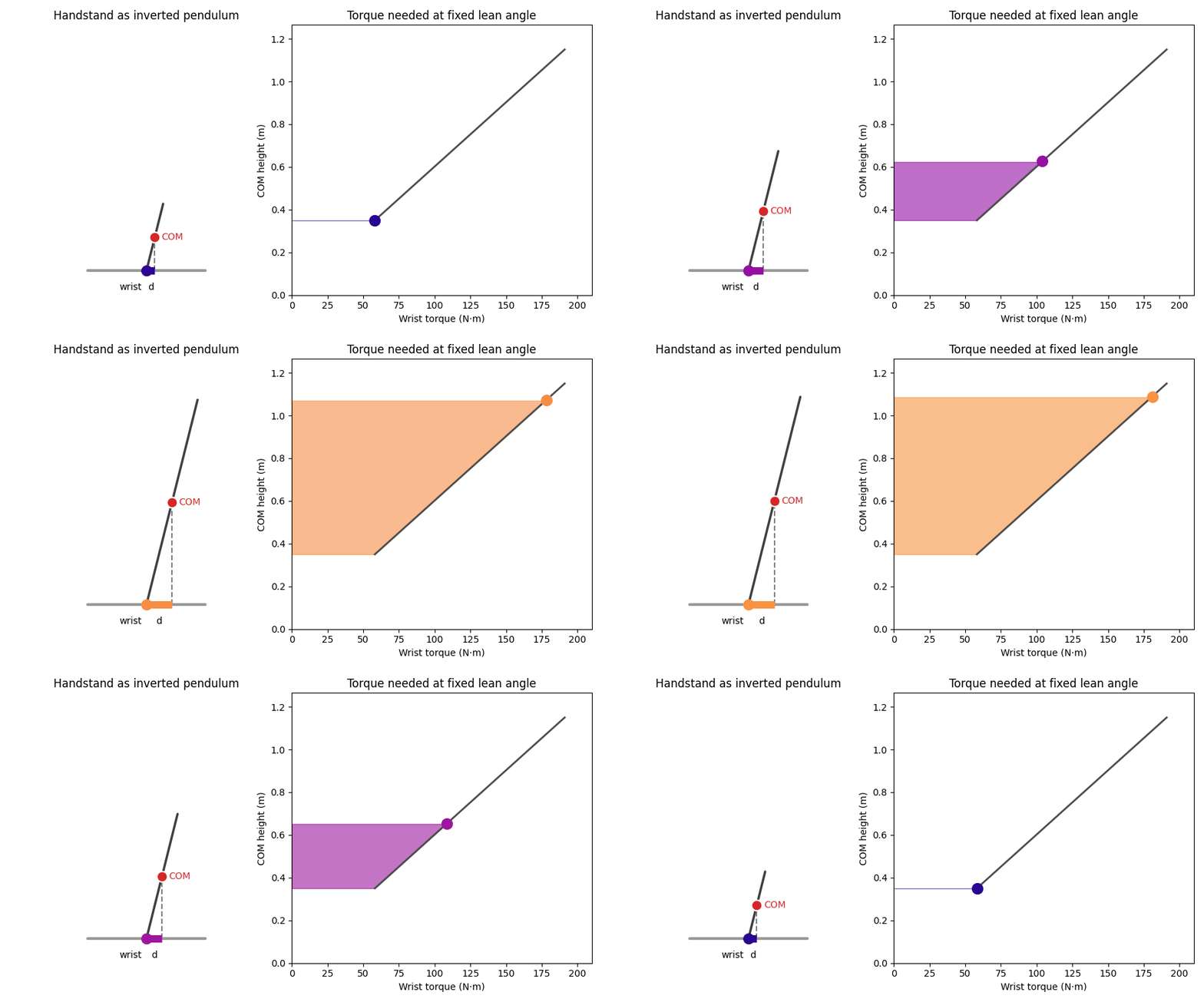
<p>First result: the magnitude of the torque depends on the tilt \(\theta\) and on the height \(h\) of the centre of mass. Which means it also depends on <em>how tall you are</em>.</p>

<p>In practice, everything we have done so far is analyze which force, which external element is responsible for a fall—what makes us fragile, and whether some variables carry more weight than others. All of this is useful, yet it is nothing more than a hypothesis of the world we want to move in—a world that, let’s remember, is not as ideal as the one we are modeling. In short, it’s a nice story: coherent and interesting, sure, but it’s not the whole picture. At some point, the outside world meets the inner world.</p>

<p>The study of balance strategies brings out the importance of another element called the <strong>centre of pressure</strong> (CoP), which is the point of application where all the ground reaction forces from the floor converge. In practice, it’s the point of contact with the world, the point of passage from passive to active, where gravity goes from being something you endure to something you manage. The centre of pressure comes out of gait analysis and postural studies, but it applies just as well to the handstand.</p>

<p>We’ll pretend to make meet outside and inside worls right here: the moment we stop looking at what happens to our center of mass and start paying attention to what we feel on the palms of our hands, the only point where we can actually act, and through them, perhaps, bring our center of mass back under control.</p>

<h2 id="control-theory-a-negotiation-between-the-body-the-environment-the-task">Control theory: a negotiation between the body, the environment, the task</h2>

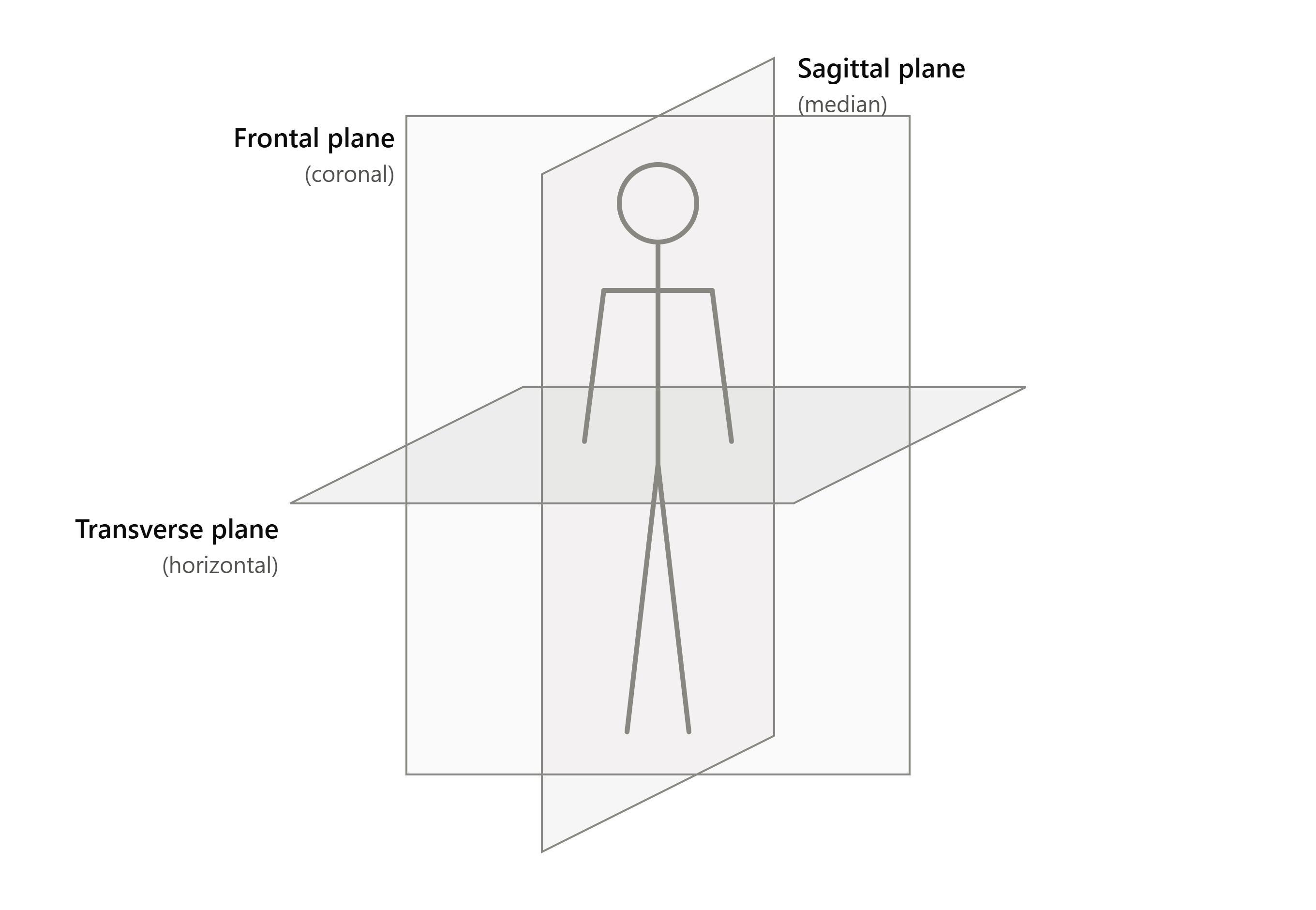
<p>Let’s give all this unapologetically mathematical talk a deep, individual, neuromuscular meaning. To manage gravity, the body uses joint strategies depending on how gross the movement we need to correct is, relying on the ankles, hips and knees. In the case of the handstand, of course, the joint most called upon is the wrists, and this strategy is called <strong>the wrist strategy</strong> among several studies of the handstand itself, which have examined how balance is maintained and controlled in the anterior–posterior direction. It’s not always like this, obviously things are more complicated than that. But these studies, conducted among experienced athletes, have shown that wrist strategy is actually the most commonly used to recover balance when the centre of mass is swaying outside its stability range. So we can make one more assumption, and pretend we’re referring to experienced athletes who rely primarily on this control strategy.</p>

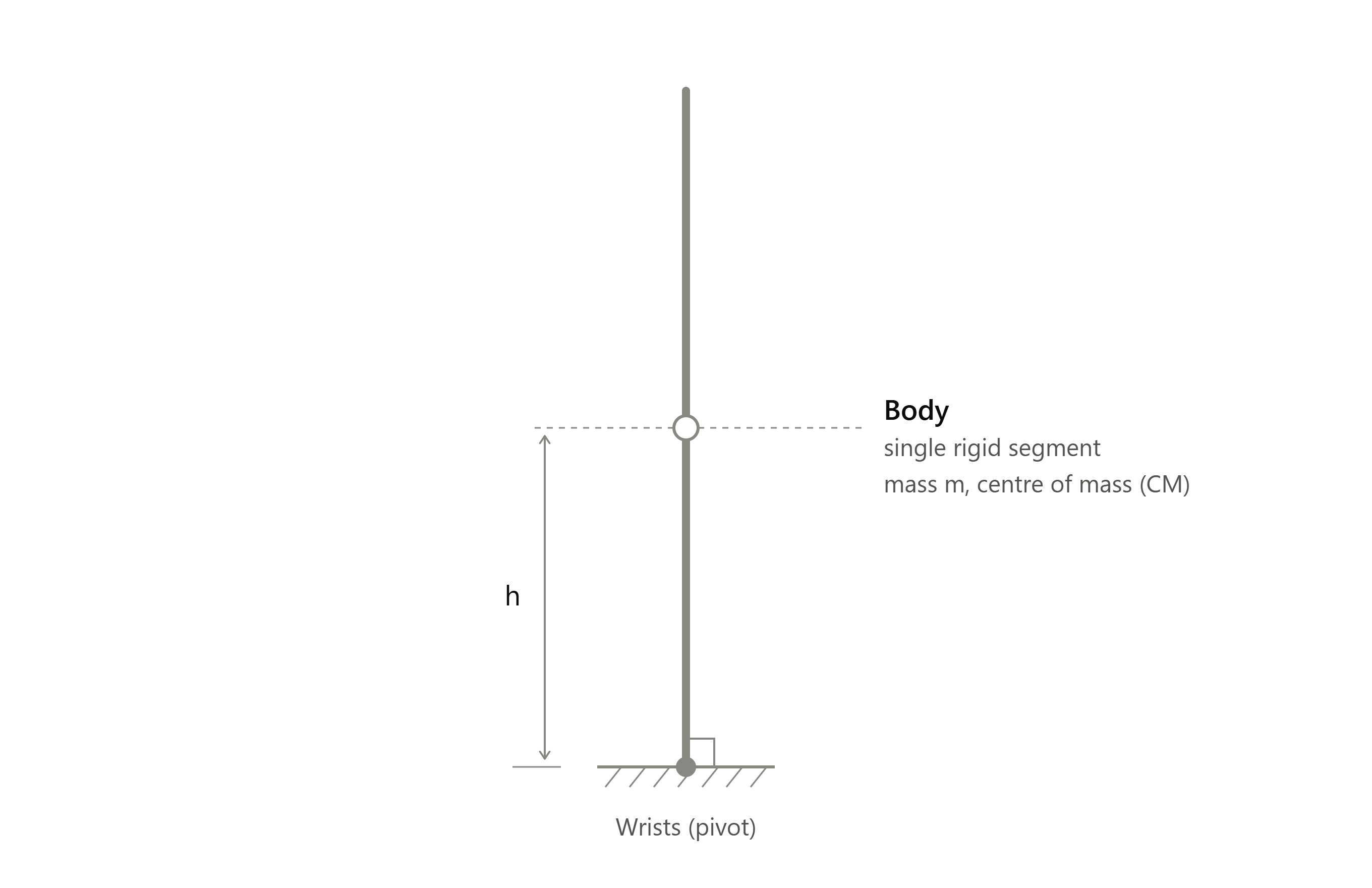
<p>This is the strategy we’ve seen so far, with the rigid-body assumptions we’ve made up to now, in which nothing else moves or creates levers or twists. And remembering our other usual assumptions, the body is a rigid stick of mass \(m\) and length \(H\) rotating about the wrist, with the centre of mass (CoM) at distance \(h\) from the pivot.</p>

<p>Let:</p>

<ul>
  <li>\(\theta\) be the inclination from the vertical (positive towards the fingers);</li>
  <li>\(d = h\sin\theta\) the horizontal position of the CoM relative to the wrist;</li>
  <li>\(c\) the position of the CoP under the hand, also relative to the wrist.</li>
</ul>

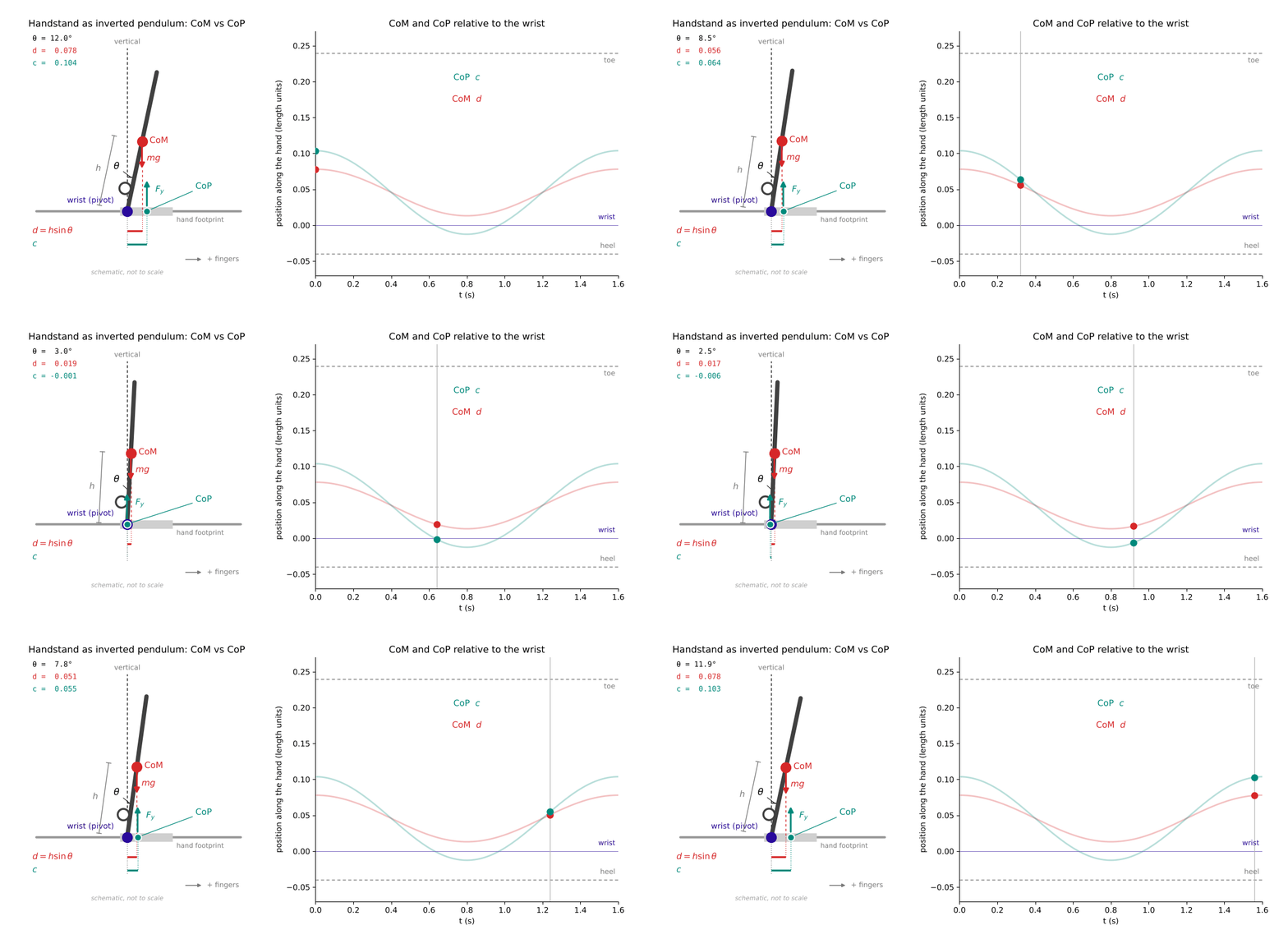
<p>The CoP can only lie within the hand footprint.This is where the problem changes character: once the CoP is introduced, balance is no longer only about where the body is, but also about where the body is able to push against the ground (Figure 1).</p>

<figure>
  <img src="/assets/img/cop/handstand_center_of_pressure_model.gif" alt="centre of mass vs centre of pressure" />
  <figcaption>
    Figure 1. Centre of mass (CoM), centre of pressure (CoP) and hand footprint.
  </figcaption>
</figure>

<p>At every instant, the model is defined by two quantities:</p>

<ul>
  <li>the position of the <strong>centre of mass (CoM)</strong> relative to the wrists, determining how gravity tends to tilt the body</li>
  <li>the position of the <strong>centre of pressure (CoP)</strong> under the hands, that determines where the ground reaction force acts</li>
</ul>

<p>Think of a handstand as a constant tug-of-war between two points: your CoM (where gravity pulls you down) and your CoP (where the floor pushes you back up through your hands). Together, these two positions tell the whole story of what your body is doing at any given instant.</p>

<p>Usually, writing out the physics of a handstand gets messy because of all the unknown internal forces acting inside the wrist joint. However, we can use a mathematical trick: if we choose the wrist as our pivot point when calculating rotational forces (torques), those unknown joint forces mathematically cancel out.</p>

<p>In out model, positive shear force is defined toward the fingers, that is, in the direction of the body’s horizontal acceleration. Since the model is symmetric, the total load is assumed to be shared equally between the two hands, and all reported values refer to a single wrist.
Around the wrist, gravity pulls the CoM forward (at horizontal distance \(d = h\sin\theta\)) with a tipping torque \(mg\,d\), while the ground reaction force pushes up at the CoP (at distance \(c\)) with a counter-torque \(F_y\,c\). That gives us the rotational equation for angular acceleration \(\ddot{\theta}\):</p>

\[I\ddot{\theta} = mg\,d - F_y\,c\]

<p>Meanwhile, linear motion links the body’s acceleration to the external forces:</p>
<ul>
  <li>horizontally: \(m\ddot{x}_{\text{CoM}} = F_x\) (with \(\ddot{x}_{\text{CoM}}\) coming from the geometry of \(\theta\))</li>
  <li>vertically, \(m\ddot{y}_{\text{CoM}} = F_y - mg\)</li>
</ul>

<p>Combining these lets us isolate \(\ddot{\theta}\) from the positions of the CoM and CoP—and once we know how the body is accelerating, we can plug that acceleration right back in to solve for the forces and wrist torque.</p>

<p>In practical terms, this means we don’t need to measure complex internal muscle tensions to see what is happening. Just by knowing your body’s lean and where you feel pressure under your palms, the model immediately tells us whether you are falling forward or backward, how fast, and what that move demands from the wrists.</p>

<p>Four quantities are monitored:</p>

<ul>
  <li>the <em>vertical force</em> \(F_y\) (\(N\)), which supports body weight;</li>
  <li>the <em>shear force</em> \(F_x\), acting parallel to the ground;</li>
  <li>the <em>resultant force</em> \(R=\sqrt{F_x^2+F_y^2}\);</li>
  <li>the <em>wrist moment</em> \(M_w\), representing the torque that must be sustained by the wrist structures and surrounding muscles.</li>
</ul>

<h2 id="the-heat-map-the-space-where-you-can-feel-the-balance">The heat map: the space where you can feel the balance</h2>

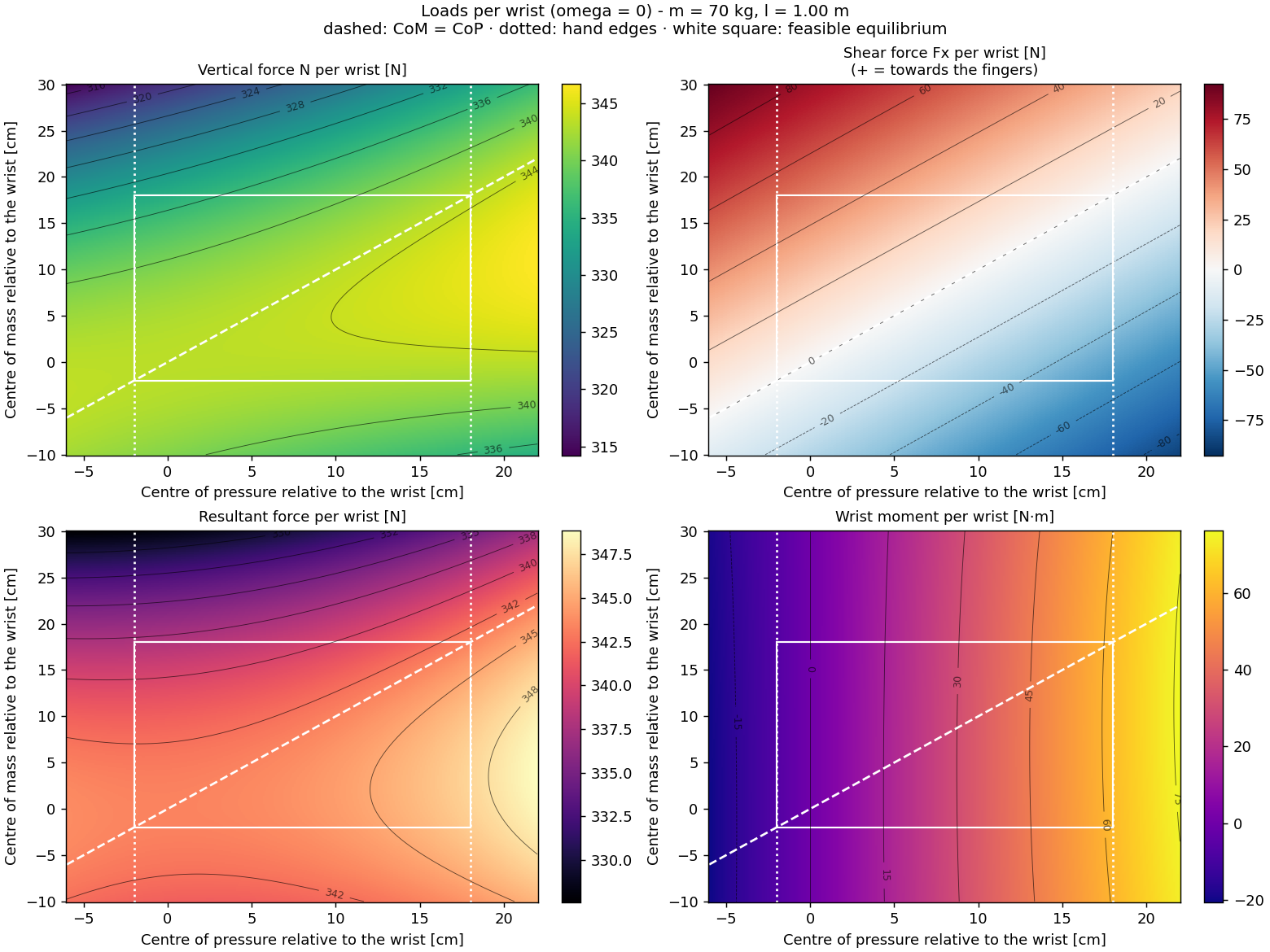
<p>Rather than evaluating the equations for only one posture, we solve them across an entire grid of CoM and CoP locations. The result is a map showing how wrist loads shift throughout the balance space, revealing not only whether a posture is dynamically stable, but also how costly it is for the wrists (Figure 2).</p>

<p>To ground the math in a concrete athlete, we start with a reference model:</p>

<ul>
  <li>Body mass \(m\): 70 kg (body weight 687 N, 343 N per wrist)</li>
  <li>Wrist-to-CoM distance \(h\): 1.00 m</li>
  <li>Body height \(H\): 1.75 m</li>
  <li>Hand length: 20 cm</li>
  <li>Hand footprint: 2 cm behind the wrist to 18 cm in front of it</li>
</ul>

<figure>
  <img src="/assets/img/cop/maps_cop_com.png" alt="Loads per wrist as functions of CoP and CoM" />
  <figcaption>
    Figure 2. Heat maps of the vertical force, shear force, resultant force and wrist moment as functions of CoP and CoM. Loads per wrist as functions of CoP (horizontal axis) and CoM (vertical axis), both relative to the wrist. Dashed line: CoM = CoP. Dotted lines: hand edges. White square: region where equilibrium is feasible, with CoM and CoP both inside the hand.
  </figcaption>
</figure>

<p>Explaining these four panels:</p>

<h4 style="text-align: left;" id="1-the-white-square-where-balance-lives">1. The white square: where balance lives</h4>

<p>Start with the white square in the middle of each panel. It defines the entire region where balance is physically possible, with both CoM and CoP inside the hand footprint:</p>

<ul style="text-align: left;">
  <li>To correct a <strong>forward fall</strong>, the CoP must move in front of the CoM by pressing through the fingers</li>
  <li>To correct a <strong>backward fall</strong>, the CoP must move behind the CoM by loading the heel of the hand</li>
</ul>

<p>Whether you actually have that correction available depends on how much physical room remains between your CoM and the edges of your hand. As we will see next, <em>this geometric boundary turns out to be even more limiting than the raw magnitude of the forces themselves</em>.</p>

<h4 style="text-align: left;" id="2-in-static-equilibrium-your-wrists-carry-torque-not-extra-vertical-weight">2. In static equilibrium, your wrists carry torque (not extra vertical weight)</h4>

<p>Along the dashed diagonal, the CoM sits vertically above the CoP (\(d = c\)) and the body does not accelerate:</p>

\[F_x = 0\]

<p>and</p>

\[M = \frac{mg}{2}c \approx 3.4\ \text{N·m per cm of } c.\]

<p>Putting the CoP at 9 cm gives about 30.9 N·m per wrist, whereas pushing all the way to the fingertips (18 cm) roughly doubles that to 62 N·m. Look at the lower-right panel: the iso-lines run vertically. That tells us the wrist moment depends primarily on the CoP position itself, so even when perfectly balanced, holding farther toward the fingers directly increases the torque your wrists and forearm muscles have to sustain.</p>

<h4 style="text-align: left;" id="3-away-from-equilibrium-shear-force-takes-over">3. Away from equilibrium, shear force takes over</h4>

<p>As soon as the CoM and CoP separate, horizontal shear force (\(F_x\)) becomes the key player. Its iso-lines run parallel to the diagonal \(d = c\) because, to first approximation, it is the offset between the two positions:</p>

\[d - c\]

<p>that drives it:</p>

<ul>
  <li>zero on the diagonal (\(d = c\))</li>
  <li>positive when the CoM is ahead of the CoP (tipping toward the fingers)</li>
  <li>negative when the CoM is behind the CoP</li>
</ul>

<p>Near equilibrium, every centimetre of offset adds roughly 2.7 N of shear force per wrist—so a 5 cm offset produces about 14 N, and doubling the offset roughly doubles the shear force too.</p>

<h4 style="text-align: left;" id="4-vertical-force-barely-flinches">4. Vertical force barely flinches</h4>

<p>Interestingly, vertical force (\(F_y\)) is far less sensitive. Across most of the feasible region, it stays close to the static 343 N per wrist, shifting by only a few percent. In other words, big differences in wrist loading come mainly from <strong>wrist moments and shear forces</strong>, not from dramatic swings in vertical force.</p>

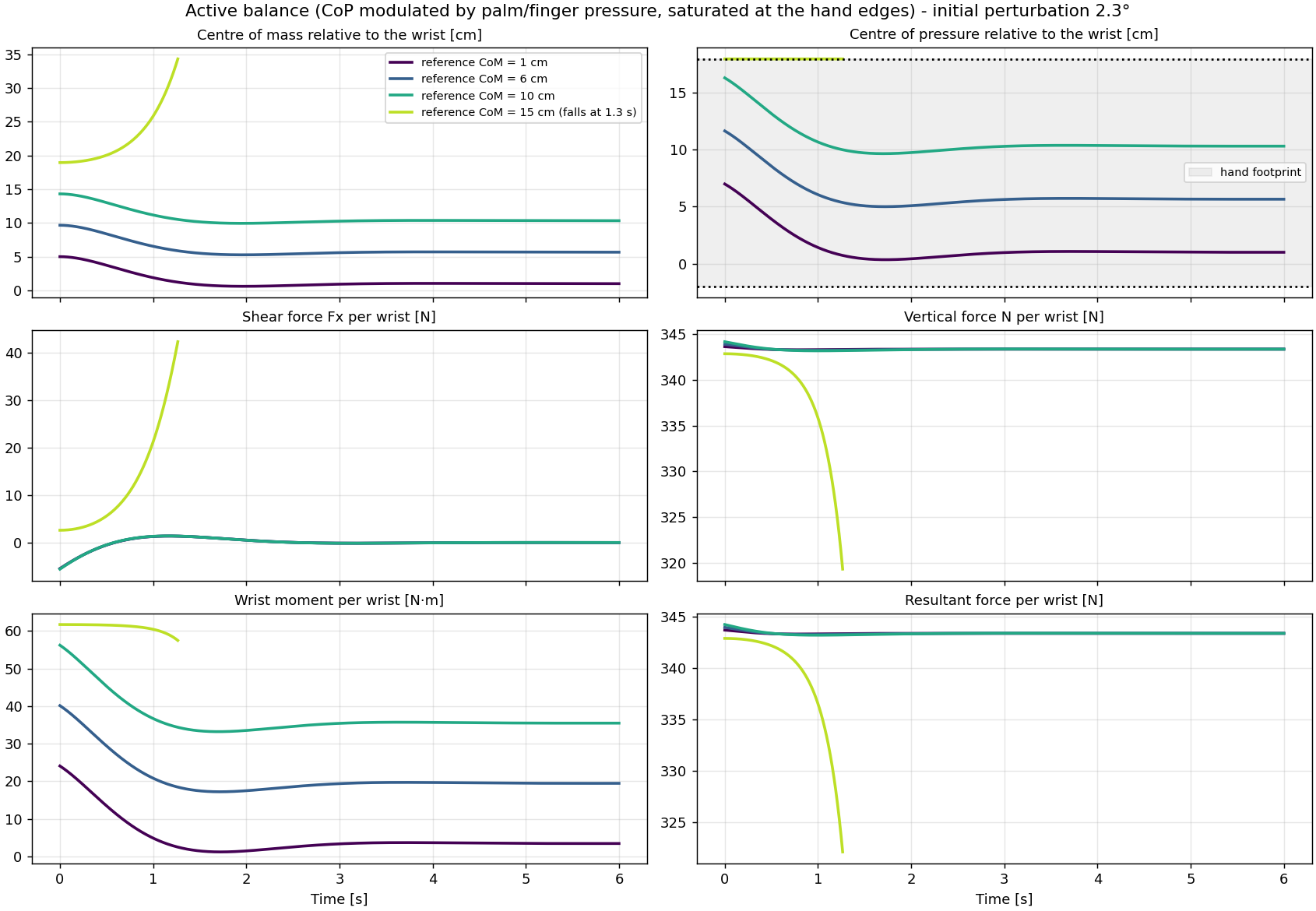
<p>To see how balance behaves in motion, we simulate a small forward nudge from rest: an initial tilt of \(0.04\ \mathrm{rad}\) (about \(2.3^\circ\), or roughly 4 cm of horizontal CoM shift). We test four starting CoM positions along the hand and consider a trial a fall if body tilt passes \(0.35\ \mathrm{rad}\) (about \(20^\circ\)), tracking both the body’s trajectory and the resulting wrist loads.</p>

<figure>
  <img src="/assets/img/cop/active_balance_simulation.png" alt="Active balance after an initial perturbation of 2.3°" />
  <figcaption>
    Figure 3. Active balance with a saturated CoP controller after an initial perturbation of 2.3°, for four reference CoM positions (1, 6, 10 and 15 cm). Grey band: hand footprint.
  </figcaption>
</figure>

<p>Three clear takeaways stand out:</p>

<ul>
  <li>1, 6, and 10 cm recover cleanly. Their dynamic transients are nearly identical, shear force stays under roughly 6 N per wrist, and the baseline wrist moment simply scales at about 3.4 N·m per centimetre of reference CoM</li>
  <li>15 cm falls after about 1.3 seconds. Braking the nudge would require moving the CoP to roughly 21 cm—beyond the 18 cm fingertip edge—so the controller saturates and can no longer save the balance</li>
  <li>once a fall begins, the plotted loads lose physical meaning because the model assumes a flat hand on the floor</li>
</ul>

<p>The key lesson here is sharp: failure isn’t caused by excessive force, because the loads remain modest. Failure happens because the needed CoP lies outside the hand footprint—it is a controllability limit, not a strength limit.</p>

<h2 id="failure-mode-the-handstand-collapse">Failure mode: the handstand collapse</h2>

<p>A nudge of 4 cm is just one test. How far can the body lean before recovery becomes impossible? What is the <strong>recoverable balance margin</strong>, the largest initial lean from rest that can still be saved? Expressing this limit as horizontal CoM displacement (in centimetres) makes robustness intuitive: it shows how far your CoM can drift from its reference spot and still be brought back inside the hand.</p>

<table style="width: 100%; border-collapse: collapse; background-color: #ffffff; color: #111111; margin: 1.5em 0;">
  <thead>
    <tr style="background-color: #ffffff; border-bottom: 1.5px solid #222222;">
      <th style="text-align: left; padding: 8px 4px; background-color: #ffffff;">Reference CoM</th>
      <th style="text-align: left; padding: 8px 4px; background-color: #ffffff;">Max forward recovery</th>
      <th style="text-align: left; padding: 8px 4px; background-color: #ffffff;">Max backward recovery</th>
      <th style="text-align: left; padding: 8px 4px; background-color: #ffffff;">Wrist moment at reference</th>
    </tr>
  </thead>
  <tbody>
    <tr style="background-color: #ffffff; border-bottom: 1px solid #eeeeee;">
      <td style="padding: 8px 4px; background-color: #ffffff;">3 cm</td>
      <td style="padding: 8px 4px; background-color: #ffffff;">15.0 cm</td>
      <td style="padding: 8px 4px; background-color: #ffffff;">5.0 cm</td>
      <td style="padding: 8px 4px; background-color: #ffffff;">10.3 N·m</td>
    </tr>
    <tr style="background-color: #ffffff; border-bottom: 1px solid #eeeeee;">
      <td style="padding: 8px 4px; background-color: #ffffff;">8 cm (mid-hand)</td>
      <td style="padding: 8px 4px; background-color: #ffffff;">10.0 cm</td>
      <td style="padding: 8px 4px; background-color: #ffffff;">10.0 cm</td>
      <td style="padding: 8px 4px; background-color: #ffffff;">27.5 N·m</td>
    </tr>
    <tr style="background-color: #ffffff; border-bottom: 1px solid #eeeeee;">
      <td style="padding: 8px 4px; background-color: #ffffff;">9 cm</td>
      <td style="padding: 8px 4px; background-color: #ffffff;">9.0 cm</td>
      <td style="padding: 8px 4px; background-color: #ffffff;">11.0 cm</td>
      <td style="padding: 8px 4px; background-color: #ffffff;">30.9 N·m</td>
    </tr>
    <tr style="background-color: #ffffff; border-bottom: 1.5px solid #222222;">
      <td style="padding: 8px 4px; background-color: #ffffff;">15 cm</td>
      <td style="padding: 8px 4px; background-color: #ffffff;">3.0 cm</td>
      <td style="padding: 8px 4px; background-color: #ffffff;">17.0 cm</td>
      <td style="padding: 8px 4px; background-color: #ffffff;">51.5 N·m</td>
    </tr>
  </tbody>
</table>

<p style="font-size: 0.9em; color: #555555; margin-top: -0.8em; margin-bottom: 1.5em;">
  <strong>Table 1.</strong> Recoverable CoM displacement (within ~0.1 cm resolution) and baseline wrist moment per wrist across four reference CoM positions.
</p>

<p>The rule is remarkably clean: your forward recovery margin matches the distance from your reference CoM to the fingertips, and your backward margin matches the distance to the heel of the hand. Balance is recoverable as long as the CoM can still be pulled back within the hand footprint.</p>

<ul>
  <li>At mid-hand (8 cm): forward and backward margins are equal (<strong>10.0 cm</strong> each) at a moderate wrist moment of about <strong>27.5 N·m</strong> per wrist</li>
  <li>Closer to the wrist: wrist moment drops, but backward recovery room shrinks</li>
  <li>Closer to the fingers: wrist moment rises, and forward recovery room shrinks</li>
</ul>

<p>Once again, the trade-off is clear: <em>lower wrist load and wider balance margins do not peak at the same posture.</em></p>

<h2 id="another-hypothesis-about-my-world">Another hypothesis about <em>my</em> world</h2>

<p>In the handbalancing world, ask whether taller people struggle more with handstands and the answer arrives almost before the question finishes—obvious, settled, woven into gym lore. This brings us back to the quiet thread running beneath the whole article: does body height really matter, or are we just looking at a different kind of weather?</p>

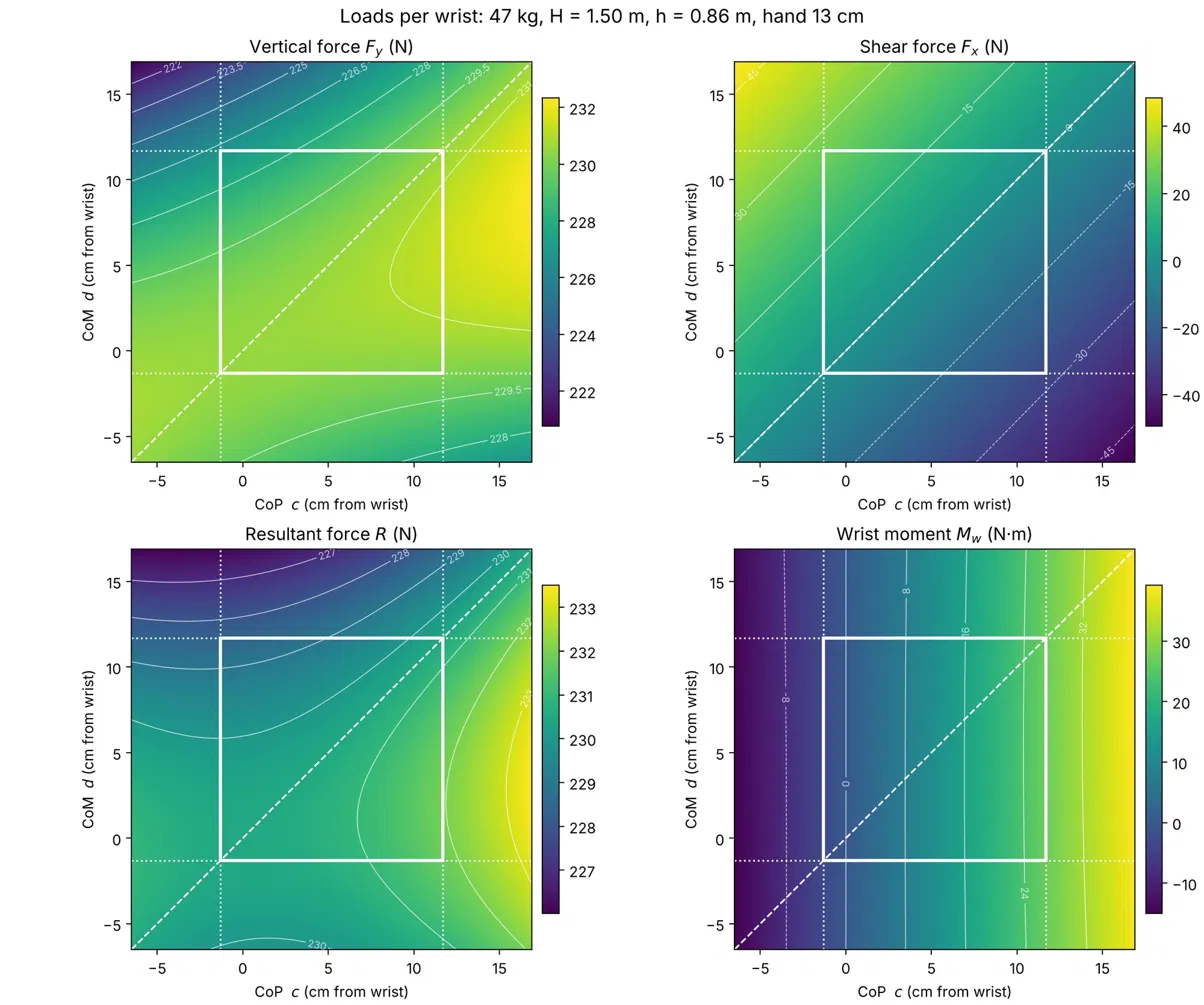
<p>As someone who loves learning through experience, I need to measure this rather than merely inherit it. So let’s trace the heat maps again—our balance space—through my own coordinates: 47 kg, 150 cm tall, CoM at 0.86 m from the wrist, and a 13 cm hand footprint (from roughly -1.3 cm behind the wrist to +11.7 cm at the fingertips).</p>

<figure>
  <img src="/assets/img/cop/maps_cop_com_47kg.webp" alt="Loads per wrist for a 47 kg athlete with a 13 cm hand footprint" />
  <figcaption>
    Figure 4. Heat maps of vertical force (\(F_y\)), shear force (\(F_x\)), resultant force (\(R\)), and wrist moment (\(M_w\)) per wrist for a 47 kg athlete (\(H = 1.50\text{ m}\), \(h = 0.86\text{ m}\), hand footprint from about \(-1.3\text{ cm}\) to \(+11.7\text{ cm}\)). Dashed line: CoM = CoP. Dotted lines: hand edges. White square: feasible balance region.
  </figcaption>
</figure>

<p>On the force side, the discount is immediate: static vertical load drops to around 230 N per wrist, and even reaching all the way to the fingertips (11.7 cm) costs roughly 27 N·m of wrist moment—less than what the 70 kg model pays near mid-hand. At the same time, the white square narrows to a 13 cm window (only 6.5 cm of symmetric margin from its center at 5.2 cm), and a lower CoM means faster angular acceleration whenever you drift. The result is a handstand that is physically much more economical, yet geometrically much more demanding than the 70 kg model. Put simply, your handstand lives in a regime where strength costs almost nothing, but precision is everything.</p>

<p>Wander from that small frame into the math of height and the picture shifts subtly. Gravitational torque scales with the distance \(h\) between the wrist and the centre of mass:</p>

\[\tau_g
=
mgh\sin\theta.\]

<p>For the same lean angle, a larger \(h\) asks for more torque. For small angles, horizontal CoM displacement is approximately</p>

\[d \approx h\theta,\]

<p>so the same tilt carries the centre of mass farther out when the body is taller. Because the hand footprint remains roughly fixed, a given CoP travel corresponds to a narrower angular span:</p>

\[\theta_{\max}
\approx
\frac{L_{\text{hand}}}{h},\]

<p>where \(L_{\text{hand}}\) is the effective range available to the centre of pressure.</p>

<p>At first glance, this confirms the gym wisdom that tall bodies face a steeper climb. Yet rotational dynamics wander into a slightly different truth. Rotational inertia grows with height as</p>

\[I \approx mh^2.\]

<p>Combining gravitational torque and inertia gives</p>

\[\ddot{\theta}
=
\frac{g}{h}\theta,\]

<p>and a characteristic instability rate of</p>

\[\omega_n
=
\sqrt{\frac{g}{h}}.\]

<p>As \(h\) increases, that rate softens: a taller athlete does not necessarily fall faster in angular terms, because rotational inertia grows faster than gravitational torque. What shrinks is not the clock ticking down your reaction, but the angular range that wrist strategy alone can reclaim. Height, then, reshapes the geometry of control more than the speed of the fall itself.</p>

<p>So it’s not that one person has to work harder to control the handstand than the other—it’s that they have to do a different kind of work. We need to understand our own model and adopt control strategies that fit it: build good hypotheses about our world, and interact with it using the most efficient tools.</p>

<p><a href="https://dopamine-chamber.github.io/2026/10/25/handstand-balance-damped-oscillator.html">Next post →</a></p>

<h4 id="source-and-references">Source and references</h4>

<p><a href="https://www.circoteca.cl/wp-content/uploads/2019/08/Strategies-for-maintaining-a-handstand-in-the-anterior-posterior-direction-Revista-Ingles-DAVID-G.-KERWIN-GRANT-TREWARTHA-2001.pdf" target="_blank" rel="noopener noreferrer">
    University of Bath
</a> - Strategies for Maintaining a Handstand in the Anterior-Posterior Direction<br />
<a href="[[https://www.circoteca.cl/wp-content/uploads/2019/08/Strategies-for-maintaining-a-handstand-in-the-anterior-posterior-direction-Revista-Ingles-DAVID-G.-KERWIN-GRANT-TREWARTHA-2001.pdf" target="_blank" rel="noopener noreferrer](https://researchportal.bath.ac.uk/en/publications/control-strategy-for-a-hand-balance/)](https://pdfs.semanticscholar.org/b379/f56f1e52bd017e071ae18fde94f536c2a6d3.pdf)">
   Loughborough University
</a> - Control strategy for a hand balance</p>]]></content><author><name>2026 Dopamine Chamber. All rights are reserved</name></author><category term="handstand" /><category term="biomechanics" /><category term="inverted pendulum" /><category term="control theory" /><category term="embodiment" /><summary type="html"><![CDATA[Control theory and the wrist strategy: where handstand collapses?]]></summary><media:thumbnail xmlns:media="http://search.yahoo.com/mrss/" url="https://www.slowconvergence.com/assets/img/cop/handstand_center_of_pressure.png" /><media:content medium="image" url="https://www.slowconvergence.com/assets/img/cop/handstand_center_of_pressure.png" xmlns:media="http://search.yahoo.com/mrss/" /></entry><entry><title type="html">Error is data: the damped oscillator</title><link href="https://www.slowconvergence.com/2026/10/25/handstand-balance-damped-oscillator.html" rel="alternate" type="text/html" title="Error is data: the damped oscillator" /><published>2026-10-25T10:00:00+00:00</published><updated>2026-10-25T10:00:00+00:00</updated><id>https://www.slowconvergence.com/2026/10/25/handstand-balance-damped-oscillator</id><content type="html" xml:base="https://www.slowconvergence.com/2026/10/25/handstand-balance-damped-oscillator.html"><![CDATA[<p>So far, we have described the motion of the center of mass of our stick figure, where all of its mass is concentrated. For good control of a handstand, we aim for this motion to be fine and very precise. We have seen that it is not possible to obtain harmonic motion from our stick figure without introducing neuromuscular control, because, left on its own, our stick figure falls. This control is a <em>feedback rule</em>, which in the real world is exerted by our wrists. What does this feedback rule look like?</p>

<hr />
<details>
  <summary>Toolbox</summary>

  <ul>
    <li>\(\theta\) is the tilt angle of the body from the vertical</li>
    <li>\(\omega = \dot{\theta}\) its angular velocity</li>
    <li>\(m\) is the body mass</li>
    <li>\(h\) the height of the centre of mass above the wrists</li>
    <li>\(I\) the moment of inertia about the wrists</li>
    <li>\(g\) the gravitational acceleration</li>
    <li>\(\tau\) the torque applied at the wrists.</li>
    <li>Feedback control. The corrective torque is computed from the state of the system (here \(\theta\) and \(\dot{\theta}\)), so that deviations from balance are corrected as they occur.</li>
    <li>Restoring torque (active stiffness). The term \(-k_p\theta\) pushes towards the upright position, like a spring pulling a displaced mass back. The gain \(k_p\) plays the role of an effective spring constant produced by muscular action.</li>
    <li>Damping (dissipation). The term \(-k_d\dot{\theta}\) opposes motion and dissipates mechanical energy, reducing or eliminating oscillations.</li>
    <li>Net stiffness. Gravity acts on the inverted pendulum as a destabilising spring of stiffness \(mgh\). The stiffness that governs the dynamics is therefore \(k_p - mgh\).</li>
  </ul>
</details>
<hr />

<h1 id="the-feedback-stabilised-single-inverted-pendulum">The feedback-stabilised single inverted pendulum</h1>

<p>In <a href="https://dopamine-chamber.github.io/2026/10/20/an-energy-perspective.html">the previous post</a> we saw that, in our model, the wrists are the only way to change the energy and the stability of the body: without a control torque the handstand position is unstable (<em>the top of a hill</em>) and falls.</p>

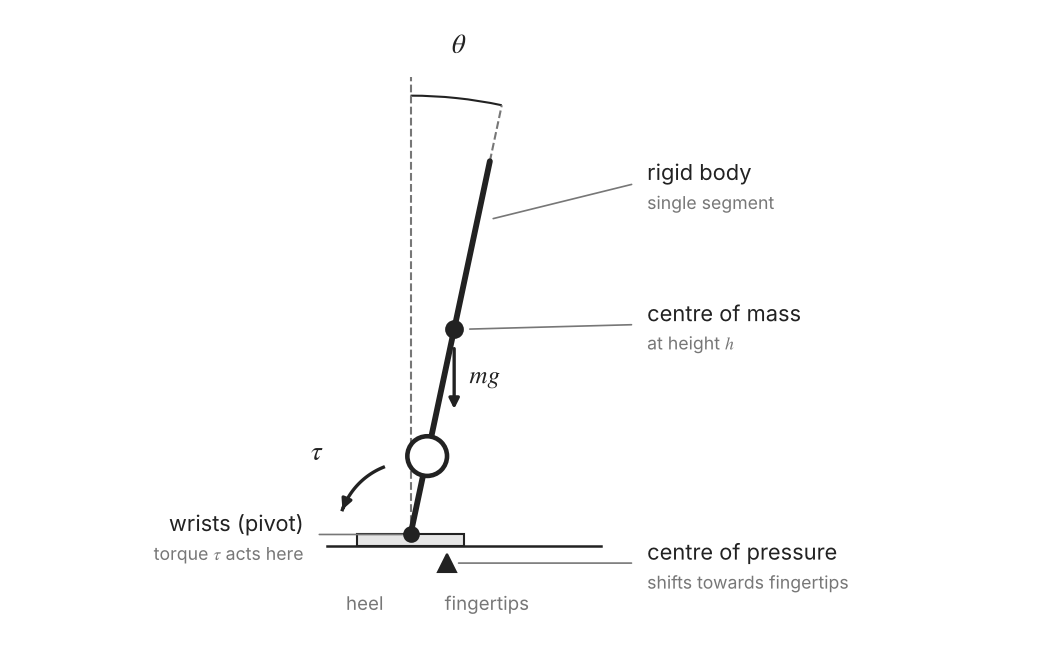
<p>To hold the balance effectively, corrections must have the right <em>direction</em>, the right <em>size</em> and the right <em>timing</em>: that is where the <em>damped oscillator</em> comes in. Introducing wrists feedback, the body behaves as a <em>feedback-stabilised inverted pendulum</em>.</p>

<p>For small angles, it behaves like a <em>damped</em> oscillator: a system pulled back towards equilibrium by a <strong>spring-like force</strong>, whose swings die out thanks to a <strong>damping term</strong>. Here, <em>stiffness and damping are produced actively by the muscles</em>. The body stays upright only if:</p>

<ul style="display: block; margin-left: 30px;">
  <li>the effective stiffness is positive</li>
  <li>there is some damping</li>
</ul>

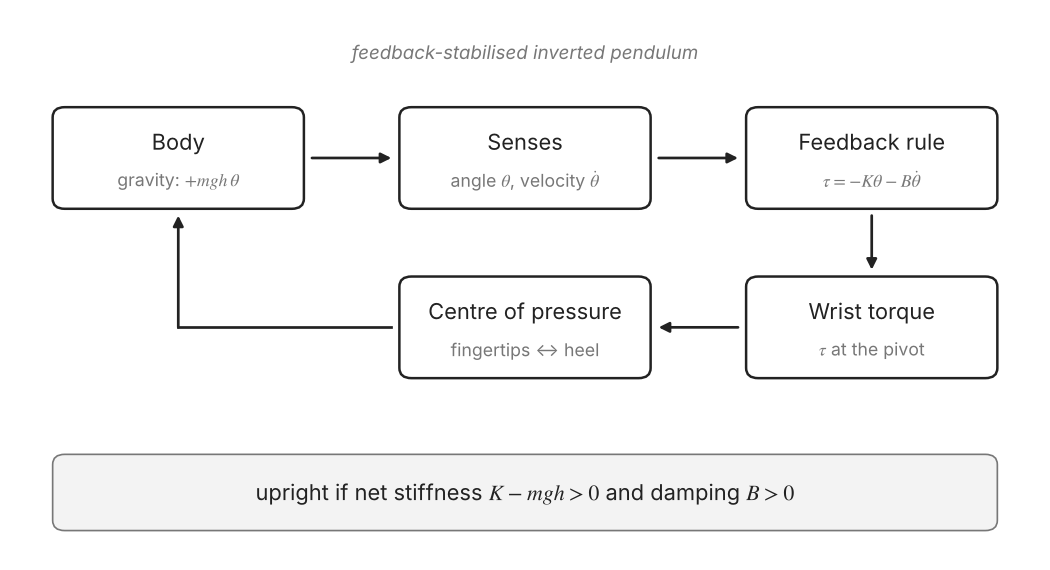
<p>In practice, the feedback rule adds a torque that depends on what the body <em>senses</em> in terms of angle and angular velocity. Here, the wrist torque of the model shows up as <em>pressure</em> shifting between the fingertips and the heel of the hand, which moves the <strong>centre of pressure</strong> under the body.</p>

<p>What the nervous system actually controls is where the pressure sits under the hands. For a point mass at height \(h\), the horizontal acceleration of the centre of mass is \(\ddot{x} = \frac{g}{h}(x - x_p)\): the body accelerates away from the CoP. Press the fingertips and the CoP moves ahead of the centre of mass, pushing the body back; ease off and it moves behind, letting the body drift forward.</p>

<figure>
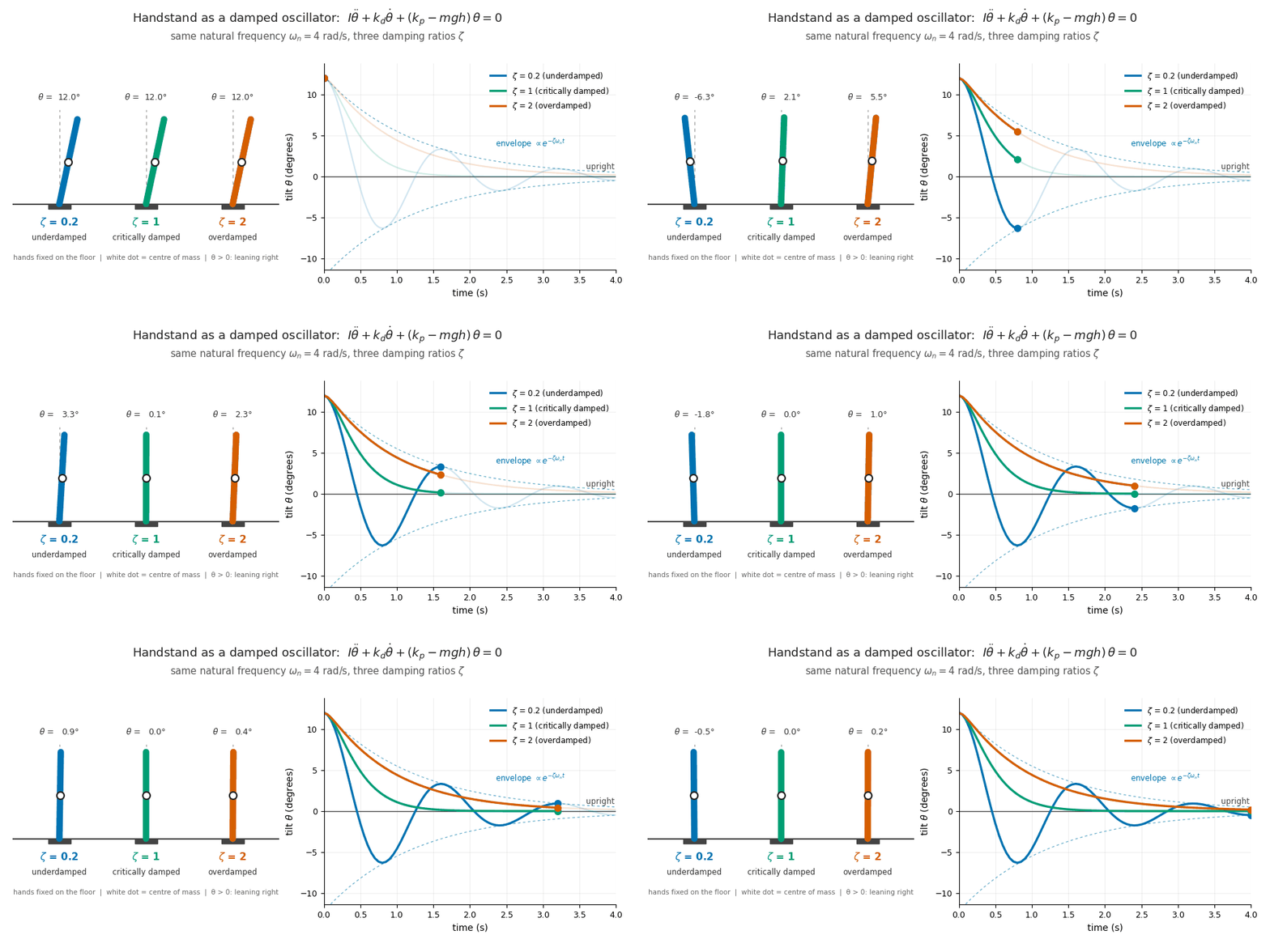
  <img src="/assets/img/damped/fig_sagittal_stickman.png" alt="Animation of three handstand-like inverted pendulums with the same natural frequency but damping ratios 0.2, 1 and 2, with their tilt angle plotted over time" loading="lazy" />
  <figcaption>Figure 1. Same natural frequency \(\omega_n\), three damping ratios \(\zeta\): underdamped (\(\zeta &lt; 1\)) the body swings while returning to the vertical; critically damped (\(\zeta = 1\)) it returns as fast as possible without swinging; overdamped (\(\zeta &gt; 1\)) it returns slowly without swinging.</figcaption>
</figure>

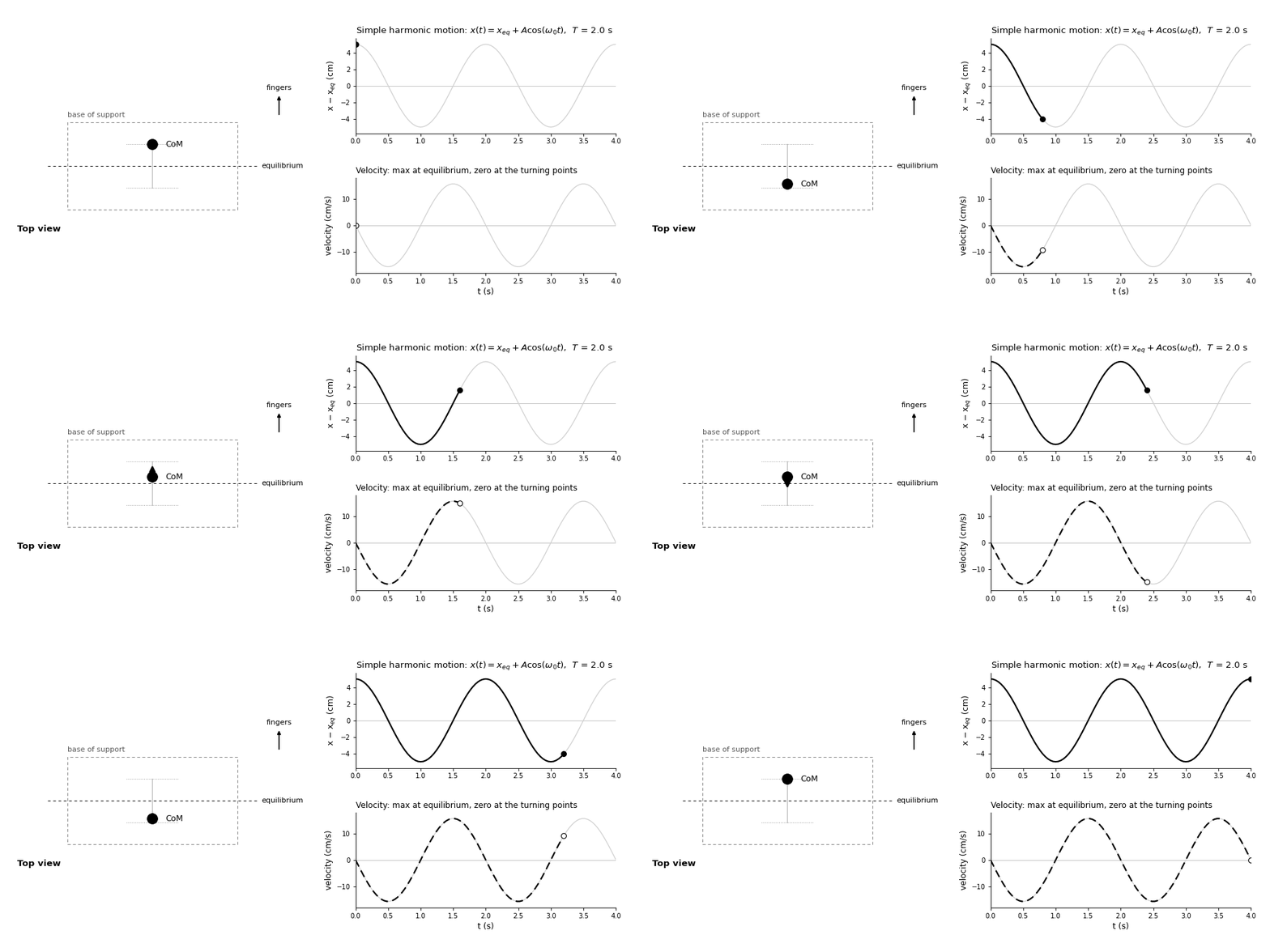
<p>This is what we saw in <a href="https://dopamine-chamber.github.io/2026/10/20/straight-two-arm-handstand-model.html"><em>The straight two-arm model and why to fit it</em></a>. Figure 3 (top view) illustrates this mechanism: when the centre of mass moves sideways relative to the hands, the hand position creates a restoring effect. By shifting the centre of pressure through the wrists, you create a corrective torque that drives the system back toward equilibrium.</p>

<h2 id="error-is-data-what-does-the-feedback-rule-look-like">Error is data: what does the feedback rule look like?</h2>

<p>This mechanism is well described by a linear Proportional-Derivative (PD) control law.</p>

<p><em>Editorial note: Models are elegant, and coming across the different model scientist have provided to formalize the handstand balance is fascinating me very hard. However, models are models, and they only help us understand the mechanics of a handstand, and mechanics tells us which joint torques are needed. Learning to produce them is another matter: it takes strength, mobility and coordination.</em></p>

<p>Anyway, PD control law is a <strong>feedback rule</strong> that combines a term <em>proportional to the error</em> with a term <em>proportional to its rate of change</em>:</p>

\[\tau = -k_p\theta - k_d\dot{\theta}\]

<p>The coefficients (gains) \(k_p\) and \(k_d\) are tuning parameters (they set how strongly and how quickly the wrists respond to a perturbation: <em>here lies the training and all other jazz!</em>)</p>

<figure>
  <img src="/assets/img/damped/fig_feedback_loop.png" alt="Animation of three handstand-like inverted pendulums with the same natural frequency but damping ratios 0.2, 1 and 2" loading="lazy" />

  <figcaption>
    Figure 2. Same natural frequency \( \omega_n \), three damping ratios \( \zeta \):
    underdamped (\( \zeta &lt; 1 \)) the body swings while returning to the vertical;
    critically damped (\( \zeta = 1 \)) it returns as fast as possible without swinging;
    overdamped (\( \zeta &gt; 1 \)) it returns slowly without swinging.
  </figcaption>
</figure>

<p>We know that without control, the linearised equation of motion is \(I\ddot{\theta} = mgh\theta + \tau\). With \(\tau = 0\) the tilt grows exponentially: this is the fall. Substituting the PD law gives:</p>

\[I\ddot{\theta} + k_d\dot{\theta} + (k_p - mgh)\theta = 0\]

<p>This is the equation of a damped harmonic oscillator with effective stiffness \(k_p - mgh\).</p>

<p>Its <em>natural frequency</em> and <em>damping ratio</em> are</p>

\[\omega_n = \sqrt{\frac{k_p - mgh}{I}}, \qquad \zeta = \frac{k_d}{2\sqrt{I\,(k_p - mgh)}}\]

<ul>
  <li>
    <p>The natural frequency (\(\omega_n\)) is the rate at which the body would sway back and forth on its own if it were nudged away from the vertical and then left alone, with no damping and nobody pushing it. It is the same idea as a mass on a spring, \(\omega_n = \sqrt{k/m}\) [rad/s], or \(f_n = \omega_n / 2\pi\) [Hz]: a stiffer spring makes it faster, a heavier mass makes it slower. For a rotation, stiffness becomes a torque per radian and mass becomes the moment of inertia (\(I\)), so in our model \(\omega_n = \sqrt{(k_p - mgh)/I}\). Gravity subtracts from the stiffness the wrists provide, which is why it is \(k_p - mgh\), and not \(k_p\) alone, that sets the rhythm. And the natural frequency exists only if \(k_p &gt; mgh\): below that threshold there is no swaying at all, only a fall.</p>
  </li>
  <li>
    <p>Stiffness (\(k_p\)) describes how strongly the body is pushed back towards the vertical in proportion to how far it has tilted (\(\theta\)). Lean a little and the correction is gentle; lean a lot and it is firm. This is the same rule as a spring: the further you stretch it, the harder it pulls back.</p>
  </li>
  <li>
    <p>Gravity, on the other hand, acts as a spring with negative stiffness, \(-mgh\): it pushes the body away from the vertical, and the further it tilts, the harder it pushes. The wrists must therefore provide a spring (\(k_p\)) stiff enough to win this contest, so that the net stiffness (\(k_p - mgh\)) stays positive.</p>
  </li>
  <li>
    <p>Damping (\(k_d\)) describes a force that opposes how fast the body is moving (\(\dot{\theta}\)), whatever its position (\(\theta\)). It works like a shock absorber: without it, a spring keeps bouncing; with it, the bouncing fades away. In a handstand, damping is what stops the body from swaying back and forth ever more widely as it overcorrects.
Unlike stiffness, damping receives no contribution from gravity: gravity depends on the tilt angle (\(\theta\)), not on its speed (\(\dot{\theta}\)). This is why the equation only needs an effective stiffness (\(k_p - mgh\)), while the damping is simply \(k_d\).</p>
  </li>
</ul>

<p>The body oscillates while returning to the vertical only if \(\zeta &lt; 1\). For \(\zeta = 1\) the return is the fastest possible without oscillation, and for \(\zeta &gt; 1\) it is slower and non-oscillatory. The spring and the damper here are not passive materials: they are the controller, that is, muscles driven by the nervous system.</p>

<figure>
  <img src="/assets/img/damped/damped-oscillator-ratio.gif" alt="Animation of three handstand-like inverted pendulums with the same natural frequency but damping ratios 0.2, 1 and 2, with their tilt angle plotted over time" loading="lazy" />
  <figcaption>Figure 3. Same natural frequency \(\omega_n\), three damping ratios \(\zeta\): underdamped (\(\zeta &lt; 1\)) the body swings while returning to the vertical; critically damped (\(\zeta = 1\)) it returns as fast as possible without swinging; overdamped (\(\zeta &gt; 1\)) it returns slowly without swinging.</figcaption>
</figure>

<h2 id="stability-conditions">Stability conditions</h2>

<p>For the upright position (\(\theta = 0\), \(\dot{\theta} = 0\)) to be asymptotically stable (meaning that the body returns to it after a small disturbance), the gains must satisfy</p>

\[k_d &gt; 0 \qquad \text{and} \qquad k_p &gt; mgh\]

<p>The condition \(k_p &gt; mgh\) says that the active stiffness produced by the muscles must exceed the destabilising pull of gravity, while \(k_d &gt; 0\) provides the dissipation. In detail, there are three cases:</p>

<ol>
  <li>If \(k_p &lt; mgh\), gravity wins and the body falls.</li>
  <li>If \(k_p &gt; mgh\) but \(k_d = 0\), the body oscillates about the vertical at frequency \(\omega_n\) without ever settling.</li>
  <li>If \(k_p &gt; mgh\) and \(k_d &gt; 0\), the body returns to the vertical.</li>
</ol>

<p>Note that the second case is a mathematical idealisation, useful for understanding the role of damping, but the real body never has zero damping: outside the assumptions of the model, even if the neural control provided no derivative term at all, the real body would still have passive damping <em>by construction</em>. This damping lies in the <em>viscosity of muscles and tendons, the internal friction of joints and soft tissues, and the deformation of the skin and hand in contact with the ground</em>.</p>

<p>In the model these effects add to \(k_d\), so the total damping is always greater than zero. An oscillation that never dies out would require a system with no energy dissipation at all, and no biological system is like that.</p>

<h2 id="energy-derivation-with-pd-control">Energy derivation with PD control</h2>

<p>Instead of solving the equation of motion, we can ask a simpler question: does the energy of the system go up or down? If it can only go down, and it has a single minimum at the balanced handstand, the body cannot drift away from it.</p>

<p>Without control,  the body is a rigid stick, with hips, shoulders and spine held fixed, pivoting about the wrists. Its mechanical energy is:</p>

\[E = \tfrac{1}{2} I \omega^2 + mgh\,(\cos\theta - 1)\]

<p>where the first term is the kinetic energy and the second is the gravitational potential energy: the centre of mass sits at height \(h\cos\theta\) above the wrists, and we subtract the constant \(mgh\) so that \(E = 0\) in the perfectly balanced handstand. As soon as the body tilts, \(\cos\theta &lt; 1\) and this term becomes negative: <em>tilting lowers the centre of mass</em>. The balanced handstand is therefore the top of a hill, not the bottom of a valley, which is why a handstand held with fully relaxed wrists collapses.</p>

<p>Adding the control spring, the proportional part of the wrist torque, \(-k_p\theta\), behaves like a spring, and a spring stores energy \(\tfrac12 k_p\theta^2\). In the real handstand, this torque appears as extra pressure on the fingertips or on the heel of the hand, depending on which way the body leans. Adding the spring energy gives</p>

\[E_c = \tfrac{1}{2} I \omega^2 + mgh\,(\cos\theta - 1) + \tfrac{1}{2} k_p \theta^2\]

<p>(\(E_c\) is a bookkeeping quantity rather than the physical energy of the body.)</p>

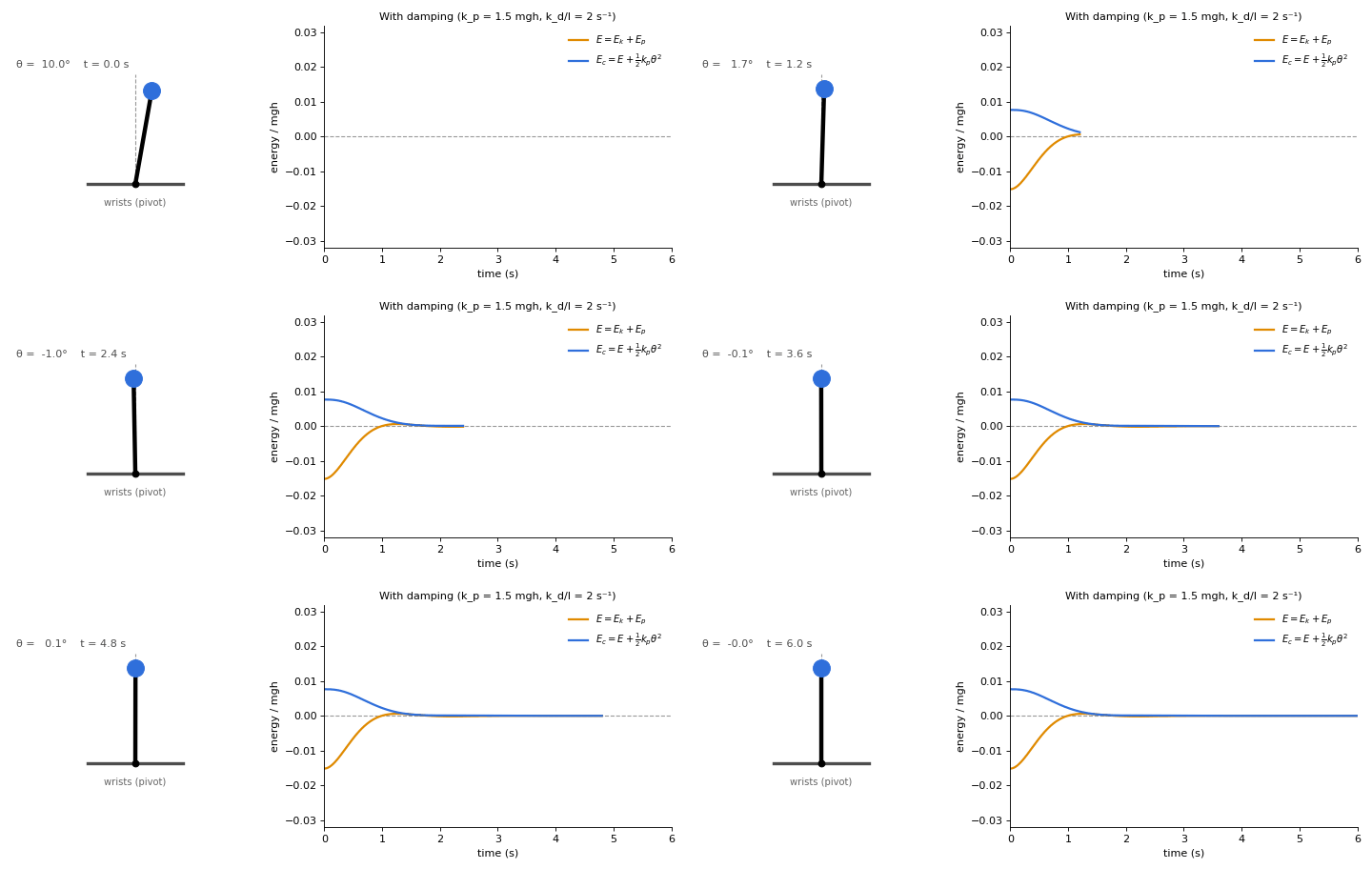
<p>How the energy changes? Gravity is already included in \(E\) as potential energy, so the only torque that does work is the wrist torque \(\tau\), and \(dE/dt = \tau,\omega\). With the PD law \(\tau = -k_p\theta - k_d\omega\), the spring term of \(E_c\) cancels the \(k_p\) part exactly, leaving</p>

\[\frac{dE_c}{dt} = -k_d\,\omega^2 \le 0\]

<p>The proportional part does not dissipate energy: it only exchanges it with the motion, like a real spring. The derivative part, which reacts to how fast the body is tilting, continuously removes energy whenever the body moves, like a brake.</p>

<p>Near the vertical, \(\cos\theta - 1 \approx -\theta^2/2\), so</p>

\[E_c \approx \tfrac{1}{2} I \omega^2 + \tfrac{1}{2}\,(k_p - mgh)\,\theta^2\]

<p>This is positive for every state except \(\theta = \omega = 0\) (it is positive definite) exactly when \(k_p &gt; mgh\). In that case \(E_c\) has the shape of a bowl with its bottom at the balanced handstand; otherwise the balanced handstand is a peak. Since \(E_c\) can never increase, the body can never climb the walls of the bowl, so it stays close to the vertical. This property is called stability.</p>

<p>Does it actually settle? Staying close to the vertical does not yet mean coming to rest there. The energy stops decreasing, \(dE_c/dt = 0\), not only at equilibrium but whenever \(\omega = 0\), even with \(\theta \neq 0\), because a brake does nothing to a body that is momentarily still, for example at the extreme of a sway. However, the body cannot remain still away from the vertical: if \(\omega\) stayed zero, \(\dot\omega\) would be zero too, and the linearised equation of motion would give \((k_p - mgh)\theta = 0\), that is \(\theta = 0\). Anywhere else, a net torque restarts the motion and the brake acts again. LaSalle’s invariance principle makes this argument rigorous: if the energy cannot increase and the motion stays bounded, the system converges to the largest set on which the energy remains constant and which the system cannot leave. Here that set is the balanced handstand alone, so the body returns to the vertical (asymptotic stability).</p>

<p>A quick check: for the linearised equation \(I\ddot\theta + k_d\dot\theta + (k_p - mgh)\theta = 0\), the solutions are combinations of \(e^{st}\), where \(s\) solves \(Is^2 + k_d s + (k_p - mgh) = 0\). When all the coefficients are positive, both roots have a negative real part (their sum is \(-k_d/I &lt; 0\) and their product is positive), so every solution decays to zero. This gives the same conditions: \(k_p &gt; mgh\) and \(k_d &gt; 0\).</p>

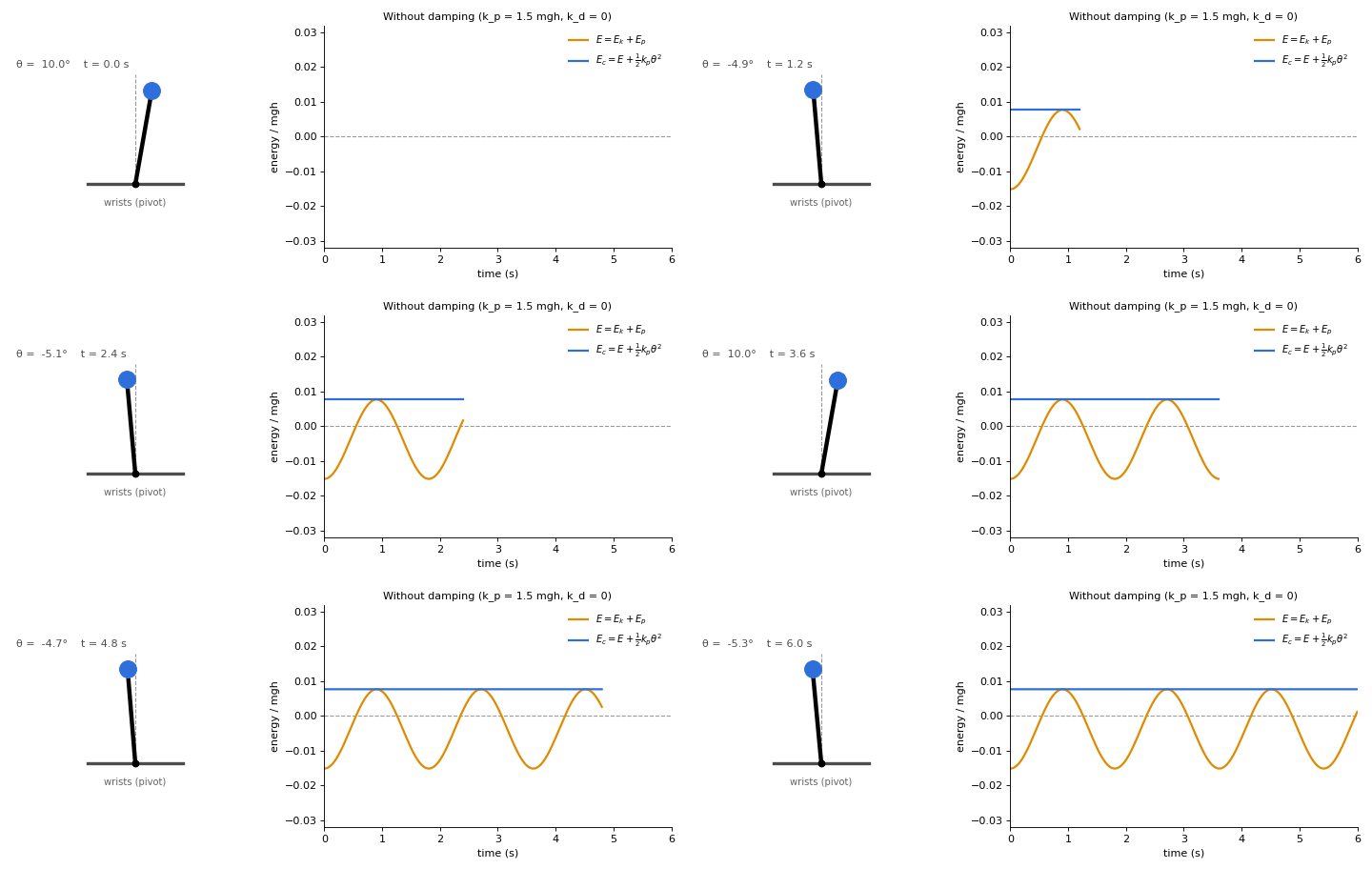
<figure> <!-- SEO: rename the file to damped-inverted-pendulum-pd-control.gif, update src, and add width/height attributes --> <img src="/assets/img/fig2_damped.gif" alt="Simulation of a handstand modelled as an inverted pendulum with PD control, returning to vertical as energy decays" loading="lazy" /> <figcaption>Figure 4. Handstand modelled as an inverted pendulum with PD control and damping (\(k_p &gt; mgh\), \(k_d &gt; 0\)). The body returns to the vertical (left). The mechanical energy \(E\) rises and falls as the torque alternately adds and removes energy (\(dE/dt = \tau\omega\)), while \(E_c\) is non-increasing (\(dE_c/dt = -k_d\omega^2 \le 0\)). Both tend to zero, the energy of the upright equilibrium.</figcaption> </figure>

<h1 id="why-delay-matters-in-a-handstand">Why delay matters in a handstand</h1>

<p>Without delay, any \(k_p &gt; mgh\) and \(k_d &gt; 0\) would be stable, however large. In reality the sensorimotor loop is slow. Yeadon and Trewartha (2003) studied four male gymnasts and estimated delays of 160 to 240 ms by regressing wrist torque against earlier values of the centre-of-mass position and velocity. These are statistical estimates from a small sample, not direct measurements, so they should be read as an order of magnitude, but they are consistent with long-latency reflexes.</p>

<p>Blenkinsop, Pain and Hiley (2016) later estimated delays of 161 ± 14 ms with a PD model and 188 ± 14 ms when a passive stiffness term was added, close to the forearm EMG latencies of 165 ± 14 ms measured in perturbed handstands. In unperturbed handstands the delays were longer (207 ± 12 ms with eyes open, 220 ± 19 ms with eyes closed).</p>

<p>With a delay, the region of stable gains in the \((k_p, k_d)\) plane becomes bounded: gains that are too high destabilise the system as well. In the linear model, over-correcting produces growing oscillations; in a real wrist, where the torque saturates, they become sustained ones. A well-tuned handstand needs enough stiffness, but not too much. For delay effects in human balancing more generally, see Stépán (2009).</p>

<p>To get a feel for the numbers, take illustrative values \(m = 70\) kg and a centre of mass 1 m above the wrists. Then \(mgh \approx 690\) N·m/rad: the wrists must supply at least that torque per radian of tilt just to cancel gravity. Treating the body as a uniform rod pivoting at one end, the uncontrolled fall has a time constant of about 0.4 s, only roughly twice the delay. That narrow margin is one reason the handstand is hard. (This is a back-of-the-envelope estimate, not a result from the studies cited.)</p>

<h1 id="a-model-not-a-law">A model, not a law</h1>

<p>The PD law is a model of what the nervous system does, and estimates such as the delay depend on the model used: the two Blenkinsop et al. (2016) values above come from two different models of the same data.</p>

<p>The model also has limits. The torque at the wrists is bounded by the size of the contact area under the hands: the centre of pressure cannot leave the hands, so large perturbations cannot always be recovered and the linear model stops being valid. And the wrists are not alone. Yeadon and Trewartha (2003) found that a fixed-configuration strategy accounted for 86% of the variance of both shoulder and hip torques, while Blenkinsop et al. (2017) found the wrist strategy to be the most prevalent in handstand (more than 75% of the time), with strategies used one at a time rather than together. In the next post we will build a more accurate model to capture how the other joints contribute to balance.</p>

<p><a href="https://dopamine-chamber.github.io/2026/10/22/human-body-is-deformable.html">Next post →</a></p>

<h4 id="source-and-references">Source and references</h4>
<ul>
  <li><a href="https://repository.lboro.ac.uk/articles/journal_contribution/Control_strategy_for_a_hand_balance/9630269?file=17279426" target="_blank" rel="noopener noreferrer">Loughborough University Repository</a> - Control strategy for a hand balance</li>
  <li><a href="https://royalsocietypublishing.org/rsos/article/4/7/161018/93310/Balance-control-strategies-during-perturbed-and" target="_blank" rel="noopener noreferrer">Royal Society Open Science</a> - Balance control strategies during perturbed and unperturbed balance in standing and handstand</li>
  <li><a href="https://research.tees.ac.uk/en/publications/strategies-for-maintaining-a-handstand-in-the-anterior-posterior-/" target="_blank" rel="noopener noreferrer">Teesside University</a> - Strategies for maintaining a handstand in the anterior-posterior direction</li>
  <li><a href="https://royalsocietypublishing.org/rsta/article-abstract/367/1891/1195/17515/Delay-effects-in-the-human-sensory-system-during?redirectedFrom=fulltext" target="_blank" rel="noopener noreferrer">Philosophical Transactions of the Royal Society A</a> - Delay effects in the human sensory system during balancing</li>
  <li>Figure 1, 2, 3 and 4 - Generated via Python for dopamine-chamber.github.io</li>
</ul>]]></content><author><name>2026 Dopamine Chamber. All rights are reserved</name></author><category term="handstand" /><category term="biomechanics" /><category term="inverted pendulum" /><category term="control theory" /><summary type="html"><![CDATA[How the wrists keep a handstand upright: a damped-oscillator model with PD control, stability conditions, energy analysis and the effect of delay.]]></summary><media:thumbnail xmlns:media="http://search.yahoo.com/mrss/" url="https://www.slowconvergence.com/assets/img/damped-inverted-pendulum.png" /><media:content medium="image" url="https://www.slowconvergence.com/assets/img/damped-inverted-pendulum.png" xmlns:media="http://search.yahoo.com/mrss/" /></entry><entry><title type="html">Why a handstand is unstable: an energy perspective</title><link href="https://www.slowconvergence.com/2026/10/20/an-energy-perspective.html" rel="alternate" type="text/html" title="Why a handstand is unstable: an energy perspective" /><published>2026-10-20T10:00:00+00:00</published><updated>2026-11-01T00:00:00+00:00</updated><id>https://www.slowconvergence.com/2026/10/20/an-energy-perspective</id><content type="html" xml:base="https://www.slowconvergence.com/2026/10/20/an-energy-perspective.html"><![CDATA[<p>The intrinsic instability of the system can also be explained through the concept of energy. When we are in a handstand, we are intuitively in a state of unstable equilibrium: we are almost motionless, but because of the unfavorable configuration we occupy within the gravitational field, our potential energy is at its maximum.</p>

<hr />

<details>
  <summary><strong>Toolbox</strong></summary>

  <ul>
    <li>
      <p><strong>Dot notation</strong>: θ̇ and θ̈ are the first and second time derivatives of the tilt angle. (θ̇ = ω) is the angular velocity [rad/s]; (θ̈ = α) is the angular acceleration [rad/s²].</p>
    </li>
    <li>
      <p><strong>Small-angle approximation</strong>: for θ ≪ 1 rad, (sin θ ≈ θ) and (cos θ ≈ 1 − θ²/2). It turns the nonlinear equations into linear ones.</p>
    </li>
    <li>
      <p><strong>Mechanical power</strong>: the rate at which a force or torque transfers energy. For a torque about a fixed axis, (P = τω) [W].</p>
    </li>
    <li>
      <p><strong>Rotational kinetic energy</strong>: the energy of rotation, (Eₖ = ½I₀ω²).</p>
    </li>
    <li>
      <p><strong>Conservative force</strong>: a force whose work depends only on the start and end positions, so it can be described by a potential energy. Gravity is one.</p>
    </li>
    <li>
      <p><strong>Gravitational potential energy and reference level</strong>: the energy stored by position. For the pendulum it is mg times the height of the CoM above the wrists, h cos θ. Only changes matter, so the zero can be chosen freely; here it is the upright position.</p>
    </li>
    <li>
      <p><strong>Mechanical energy and work–energy theorem</strong>: (E = Eₖ + Eₚ). Its rate of change equals the power of the non-conservative torques: (dE/dt = τω).</p>
    </li>
    <li>
      <p><strong>Chain rule</strong>: if y depends on x and x on t, then (dy/dt = (dy/dx)(dx/dt)).</p>
    </li>
    <li>
      <p><strong>Unstable equilibrium</strong>: an equilibrium that a small disturbance makes the system leave. In the inverted pendulum it is a maximum of the potential energy (Eₚ).</p>
    </li>
  </ul>

</details>

<hr />

<h2 id="introducing-mechanical-power">Introducing mechanical power</h2>

<p>In the previous post we modelled our handstand as an inverted pendulum that want to pass as a hanging pendulum. The motion we want to reproduce is the simple harmonic motion, with our centre of mass oscillating periodically about its equilibrium position (Figure 1).</p>

<p>Keep in mind that this behaviour is only possible because of <strong>active control at the wrists</strong>. Unlike a hanging pendulum, an inverted pendulum is not governed by simple harmonic motion and cannot remain stable without continuous corrective action.</p>

<figure>
  <img src="/assets/img/fig1_undamped.gif" alt="Inverted pendulum with PD control and no damping oscillating about the vertical, with E_k constant" />
  <figcaption>Figure 1. Inverted pendulum with torque control.</figcaption>
</figure>

<p>Conceptually, I have always liked to think of these adjustments <strong>in terms of energy</strong>, because the importance of giving the right angular impulse (torque times duration) is something you learn from experience.</p>

<p>In fact, \(\frac{dE}{dt} = \tau\omega\), meaning the “power of the force” is <strong>the rate at which that force transfers energy to the system</strong>. The energy changes only through the work done by the wrists, so it is intuitive to aim at keeping it constant, but at the right value. In the following, we verify how maths supports our intuition.</p>

<p><em>Editorial note: the following part contains a lot of maths, which may make the notation a bit heavy. If you want to skip the whole mathematical treatment and go directly to what interests you most, please jump straight to the section: “Conservation of mechanical energy in SIP”. The whole picture will not change.</em></p>

<p>Recalling the rotational equation of motion:</p>

\[I\ddot{\theta} = mgh\sin\theta + \tau\]

<p>For small deviations (\(\theta \ll 1\)), we use \(\sin\theta \approx \theta\), which gives:</p>

\[I\ddot{\theta} \approx mgh\,\theta + \tau\]

<p>If the body tilts to the right (\(\theta &gt; 0\)), a negative torque is required to counteract the fall.</p>

<p>To quantify how torque transfers energy into rotational motion, we introduce <strong>mechanical power</strong> (\(P\)), expressed in <strong>watt</strong> (torque × angular velocity).</p>

<p>For a torque acting around a single axis:</p>

\[P = \tau\,\omega\]

<p>with \(\omega = \dot{\theta}\) being the angular velocity.</p>

<p>Multiplying the full (nonlinear) equation of motion by \(\omega\) turns every term into a power:</p>

\[I\ddot{\theta}\,\omega = mgh\sin\theta\,\omega + \tau\omega\]

<p>Analysing the terms:</p>

<ul>
  <li>The left-hand side represents the contribution due to rate of change of rotational kinetic energy \(E_k = \frac{1}{2}I\omega^2\) (assuming \(I\) is constant):</li>
</ul>

\[\frac{dE_k}{dt} = I\omega\dot{\omega} = I\ddot{\theta}\,\omega\]

<ul>
  <li>The gravitational term is the power of gravity. Gravity is a conservative force, so its torque can be written as minus the derivative of a potential energy \(E_p\) with respect to the angle:</li>
</ul>

\[mgh\sin\theta = -\frac{dE_p}{d\theta}\]

<p>Integrating gives:</p>

\[E_p = mgh\cos\theta + \text{const}\]

<p>Since only changes in potential energy matter, we are free to choose where it is zero.</p>

<p><em>We take the handstand position as the reference level</em> (\(\theta = 0\)), so that:</p>

\[E_p = mgh\,(\cos\theta - 1)\]

<p>Since \(\cos\theta \le 1\), we have \(E_p \le 0\): any tilt lowers the centre of mass, and with it the potential energy.</p>

<p>In other words, \(\theta = 0\) is a maximum of \(E_p\), like a ball on top of a hill. <em>Any small displacement releases potential energy, which turns into kinetic energy</em>: the upright position is an unstable equilibrium.</p>

<p>For small angles, \(\cos\theta \approx 1 - \theta^2/2\), so</p>

\[E_p \approx -\tfrac{1}{2}mgh\,\theta^2\]

<p>which is an upside-down parabola (Figure 2).</p>

<p>A torque is the negative slope of the energy. 
Differentiating \(E_p\) with respect to \(\theta\), the gravitational torque is</p>

\[-\frac{dE_p}{d\theta} = mgh\sin\theta \approx mgh\,\theta\]

<p>which is exactly the term \(mgh\,\theta\) in the linearised equation of motion, \(I_O\ddot{\theta} \approx mgh\,\theta + \tau\). Its sign is positive: <em>it pushes the body in the direction in which it is already tilted, and therefore away from the vertical</em>. 
The upside-down parabola is the same information, read as energy instead of torque: the steeper the hill, the stronger the push away from the top.</p>

<p>The same function also tells us how the energy changes in time. Because \(E_p\) depends on time only through \(\theta\), the chain rule, with \(\omega = \dot{\theta}\), gives</p>

\[\frac{dE_p}{dt} = \frac{dE_p}{d\theta}\,\omega = -mgh\sin\theta\,\omega\]

<p>so the gravitational term in the power balance is exactly \(-\frac{dE_p}{dt}\).</p>

<p>Rearranging the power balance:</p>

\[\frac{dE_k}{dt} = -\frac{dE_p}{dt} + \tau\omega \implies \frac{d}{dt}(E_k + E_p) = \tau\omega\]

<p>Defining the <strong>total mechanical energy</strong> as \(E = E_k + E_p\)</p>

<p>we obtain the energy rate equation:</p>

\[\frac{dE}{dt} = \tau\omega\]

<h2 id="conservation-of-mechanical-energy-in-the-single-inverted-pendulum">Conservation of mechanical energy in the single inverted pendulum</h2>

<p>One way to understand how the wrists must work against gravity is to think in terms of power and energy. In our single-segment model, the body has a kinetic energy (it is moving) and a gravitational potential energy (how high its centre of mass is), which give the total mechanical energy of the system:</p>

\[E = E_k + E_p = \tfrac{1}{2}I_O\omega^2 + mgh\,(\cos\theta - 1)\]

<p>To evaluate how it changes over time, we take its derivative with respect to time. Using the equation of motion gives the <strong>energy rate equation</strong>:</p>

\[\frac{dE}{dt} = I_O\omega\dot{\omega} - mgh\sin\theta\,\omega = \omega\,(I_O\ddot{\theta} - mgh\sin\theta) = \tau\omega\]

<p>The gravitational term cancels out: gravity only exchanges energy between its kinetic and potential forms, and the total energy changes only through the power \(\tau\omega\) delivered by the control torque. This is why the wrists have to supply power to work against gravity.</p>

<p><strong>The upright position is where the centre of mass is highest</strong>, and <strong>we take it as the zero of potential energy (which in our model is the maximum)</strong>: any tilt lowers the centre of mass, so gravity releases energy and the body speeds up as it falls. Intuitively, we’re balanced at the top of a hill: any small lean converts potential energy into kinetic energy and sends us rolling downhill.</p>

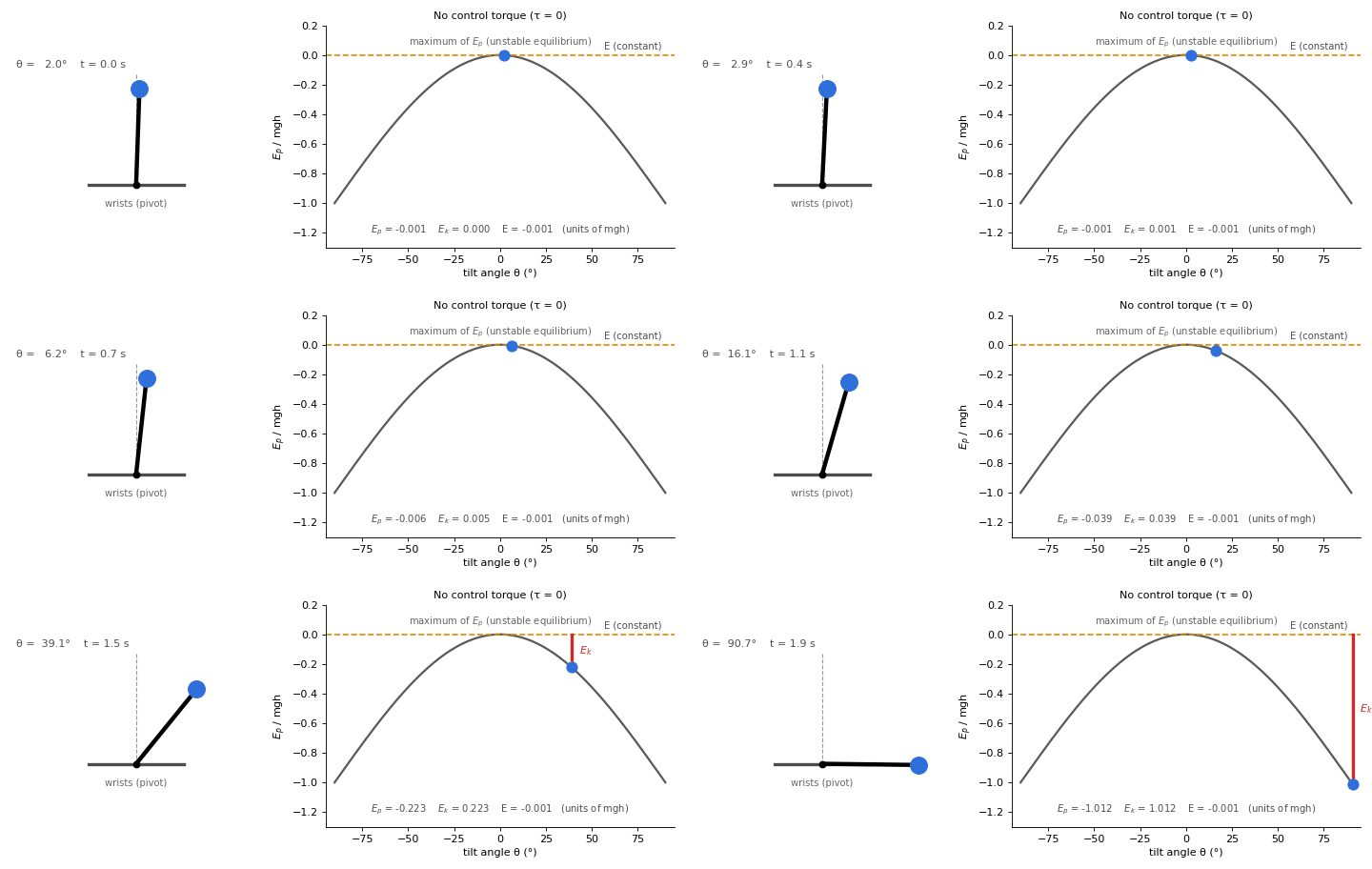
<p>As we have seen, for this to happen it is enough for the wrists to stop providing active control. In the absence of external input, left to itself, the total energy stays constant, and the body falls away from the vertical (Figure 2).</p>

<figure>
  <img src="/assets/img/fig_hilltop.gif" alt="Conservation of energy for the inverted pendulum with no control torque" />
  <figcaption>Figure 2. Conservation of energy for the inverted pendulum with no control torque (\(\tau = 0\)). The upright position is a maximum of \(E_p\), so the body falls away from it: kinetic and potential energy are exchanged while their sum \(E\) stays constant.</figcaption>
</figure>

<h2 id="balance-is-negotiated">Balance is negotiated</h2>

<p>By examining this correction qualitatively, we observe that:</p>

<ul>
  <li>With \(E &lt; 0\), the body does not have enough energy to reach the vertical. As it approaches the upright position its potential energy rises towards zero while its kinetic energy drops, until it vanishes at a tilt \( \theta_s \) given by \( \cos\theta_s = 1 + E/(mgh) \). There the body stops for an instant, and then gravity pulls it back: it falls away from the vertical on the same side it came from.</li>
  <li>With \(E &gt; 0\), the body reaches the vertical with kinetic energy to spare, \( \tfrac{1}{2}I_O\omega^2 = E \). It crosses the upright position without stopping and keeps going: it overshoots, and then falls to the other side.</li>
  <li>With \(E = 0\), we have the borderline case between the two behaviors: the body would balance on the top of the hill, but any tiny disturbance makes it fall to one side or the other.</li>
</ul>

<p>This is why flailing in response to a loss of balance backfires: a large correction can push \(E\) well above zero, and the body overshoots. A correction that is too small leaves \(E &lt; 0\), and the body falls back.</p>

<p>In an ideal world, once \(E = 0\) with the body moving towards the vertical, the wrists would have nothing left to do: \(\frac{dE}{dt} = \tau\omega = 0\), and the energy would stay constant at zero.</p>

<p>In reality, <em>noise, delays and small perturbations keep pushing \(E\) away from zero</em>, so the muscles never stop working. The energy stays close to zero, with the wrists adding or removing small amounts of it, depending on whether the torque acts along (\(\tau\omega &gt; 0\)) or against (\(\tau\omega &lt; 0\)) the motion.</p>

<p>Balancing is therefore not simply “pushing against the fall”: the wrists have to add or remove the right amount of energy at the right moments, until both the tilt and the velocity go to zero. This is why small, well-timed adjustments work better than large, abrupt ones.</p>

<p>In the next post we will see in detail the control rule that describe this fine wrist control.</p>

<p>This post is part of <em><a href="/series/">the handstand balance model</a>.
<a href="https://dopamine-chamber.github.io/2026-10-25-handstand-balance-damped-oscillator.html">Next post: cooming soon →</a></em></p>

<h4 id="sources-and-references">Sources and references</h4>
<ul>
  <li>Loughborough University Repository - <a href="https://repository.lboro.ac.uk/articles/journal_contribution/Control_strategy_for_a_hand_balance/9630269?file=17279426" target="_blank" rel="noopener noreferrer"><em>Control strategy for a hand balance</em></a></li>
  <li>
    <p>Royal Society Open Science - <a href="https://royalsocietypublishing.org/rsos/article/4/7/161018/93310/Balance-control-strategies-during-perturbed-and" target="_blank" rel="noopener noreferrer"><em>Balance control strategies during perturbed and unperturbed balance in standing and handstand</em></a></p>
  </li>
  <li>Figures 1 and 2 - <em>Generated via Python for</em> <a href="https://dopamine-chamber.github.io/" target="_blank" rel="noopener noreferrer"><em>dopamine-chamber.github.io</em></a></li>
</ul>]]></content><author><name>Benedetta Giglio</name></author><category term="handstand" /><category term="handstand physics" /><category term="inverted pendulum" /><category term="balance" /><summary type="html"><![CDATA[Why is a handstand unstable? In an energy perspective, the body sits on top of a potential-energy hill: almost motionless, yet in unstable equilibrium.]]></summary><media:thumbnail xmlns:media="http://search.yahoo.com/mrss/" url="https://www.slowconvergence.com/assets/img/fig1_undamped.gif" /><media:content medium="image" url="https://www.slowconvergence.com/assets/img/fig1_undamped.gif" xmlns:media="http://search.yahoo.com/mrss/" /></entry><entry><title type="html">The straight two-arm model and why balance is negotiated</title><link href="https://www.slowconvergence.com/2026/10/20/straight-two-arm-handstand-model.html" rel="alternate" type="text/html" title="The straight two-arm model and why balance is negotiated" /><published>2026-10-20T00:00:00+00:00</published><updated>2026-11-01T00:00:00+00:00</updated><id>https://www.slowconvergence.com/2026/10/20/straight-two-arm-handstand-model</id><content type="html" xml:base="https://www.slowconvergence.com/2026/10/20/straight-two-arm-handstand-model.html"><![CDATA[<p>In this post we will use a simplified model to start understanding why handstands are intrinsically unstable. <em>Only the model is simple, because, to me, the straight handstand is anything but simple.</em></p>

<hr />

<details>
  <summary><strong>Toolbox</strong></summary>

  <ul>
    <li>
      <p><strong>Rigid body</strong>: an idealisation in which the distance between any two points of the body stays constant: the body does not deform and can only translate and rotate. In biomechanics, the human body is often represented as a rigid-body model.</p>
    </li>
    <li>
      <p><strong>Angular velocity</strong> (ω): how fast the tilt angle changes over time [rad/s]. It is the time derivative of θ.</p>
    </li>
    <li>
      <p><strong>Angular acceleration</strong> (α): how fast the angular velocity changes over time [rad/s²].</p>
    </li>
    <li>
      <p><strong>Centre of mass</strong> (CoM): the point where the whole mass of a body can be considered concentrated, and which moves like a single particle subject to the total external force.</p>
    </li>
    <li>
      <p><strong>Lever arm</strong>: the perpendicular distance between the line of action of a force and the axis of rotation [m].</p>
    </li>
    <li>
      <p><strong>Pivot</strong>: the fixed point about which the body rotates. In the model it is the wrists.</p>
    </li>
    <li>
      <p><strong>Amplitude</strong> (θ₀): the maximum angle reached during the oscillation.</p>
    </li>
    <li>
      <p><strong>Angular frequency</strong> (ω₀): how fast the oscillation cycles [rad/s]. It is related to the period by T = 2π/ω₀.</p>
    </li>
    <li>
      <p><strong>Period</strong> (T): the time taken for one complete oscillation [s].</p>
    </li>
    <li>
      <p><strong>Moment of inertia</strong> (I₀): a measure of a body’s resistance to changes in its rotation, here about the pivot (the wrists) [kg·m²].</p>
    </li>
    <li>
      <p><strong>Control torque</strong> (τ): torque generated by the muscles, equal to the force times its lever arm [N·m].</p>
    </li>
    <li>
      <p><strong>Tilt angle</strong> (θ): angle between the body axis and the vertical [rad].</p>
    </li>
  </ul>

</details>

<hr />

<h2 id="single-inverted-pendulum-a-more-accurate-model-for-humans">Single inverted pendulum: a more accurate model for humans</h2>

<p>The body tilting in a handstand is <em>more similar</em> to what in physics is known as <strong>single inverted pendulum</strong> (SIP), a pendulum where <strong>the centre of mass is above the pivot point</strong>. Due to its configuration, the system implements <strong>control logic</strong> to not falling, being a common model used in biomechanics applications that involve <strong>balance</strong>, like gait analysis, upright position and athletic skills, including handstands. (Figure 1).</p>

<figure>
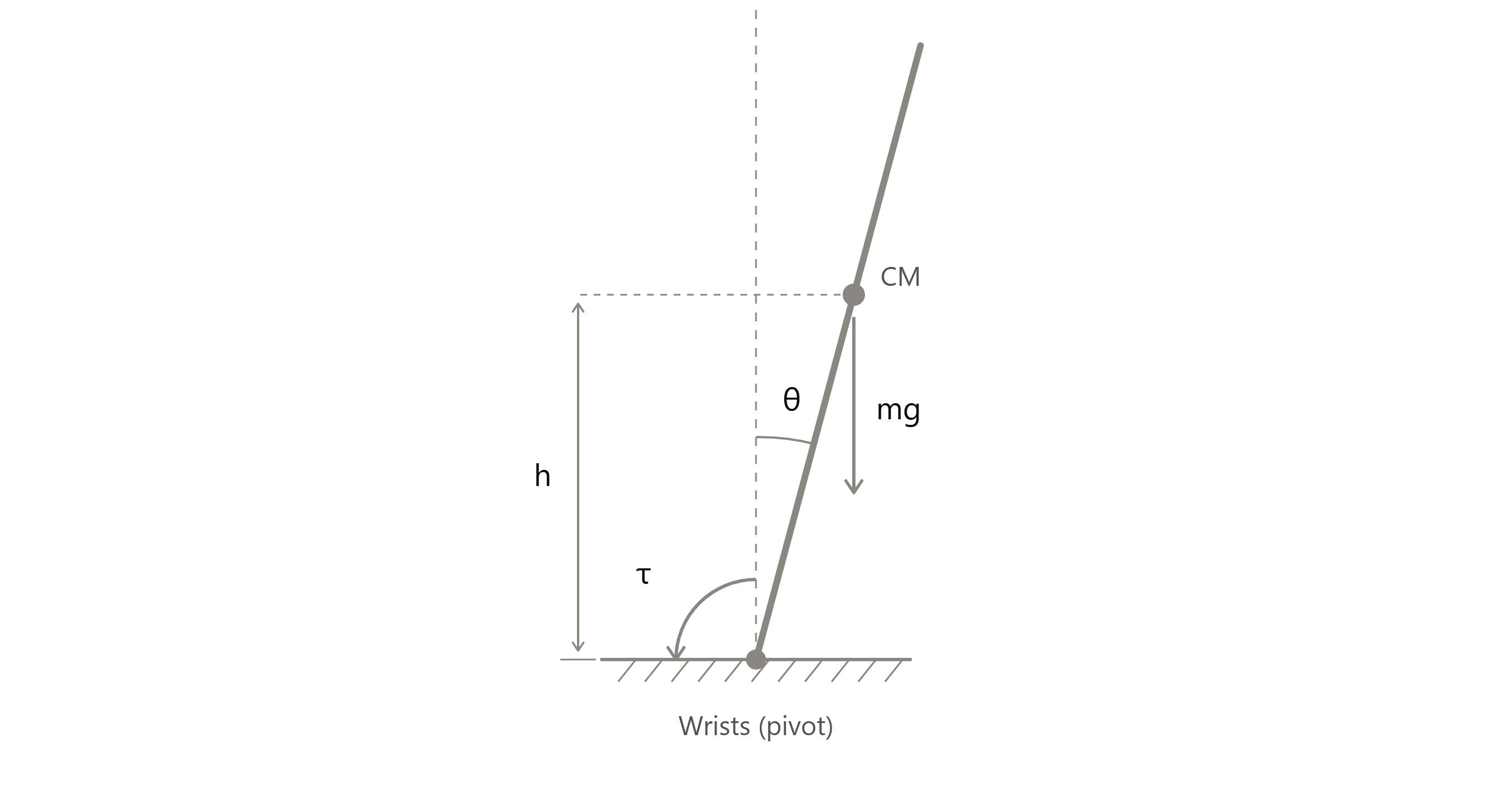
  <img src="/assets/img/inverted_pendulum_handstand_model_r1.png" alt="Inverted pendulum model" />
  <figcaption>Figure 1. Single segment inverted pendulum model for a straight two-arm handstand.</figcaption>
</figure>

<p>In this configuration, equations of motion become:</p>

\[\sum M_{O} = I_{O}\,\alpha = mgh\sin\theta+\tau = 0\]

\[mgh\sin\theta = - \tau\]

<p>where θ is the angle between the body axis and the vertical, suggesting that <strong>the magnitude of the torque generated by the wrist muscles depends on the tilt angle</strong> (Figure 2).</p>

<p>This is reasonably consistent with what we observe in practice: <em>small oscillations usually call for small adjustments</em> that are not too demanding in terms of muscular effort. When the tilt becomes too large, the wrists can no longer counteract the moment generated by gravity, and we fall.</p>

<figure>
  <img src="/assets/img/handstand_dynamic_equilibrium.gif" alt="Single inverted pendulum model" />
  <figcaption>Figure 2. Motion of the inverted pendulum.</figcaption>
</figure>

<h2 id="youre-not-a-simple-harmonic-oscillator">You’re not a simple harmonic oscillator</h2>

<p>To introduce this topic, it is helpful to briefly revisit the simple pendulum and its equation of motion.</p>

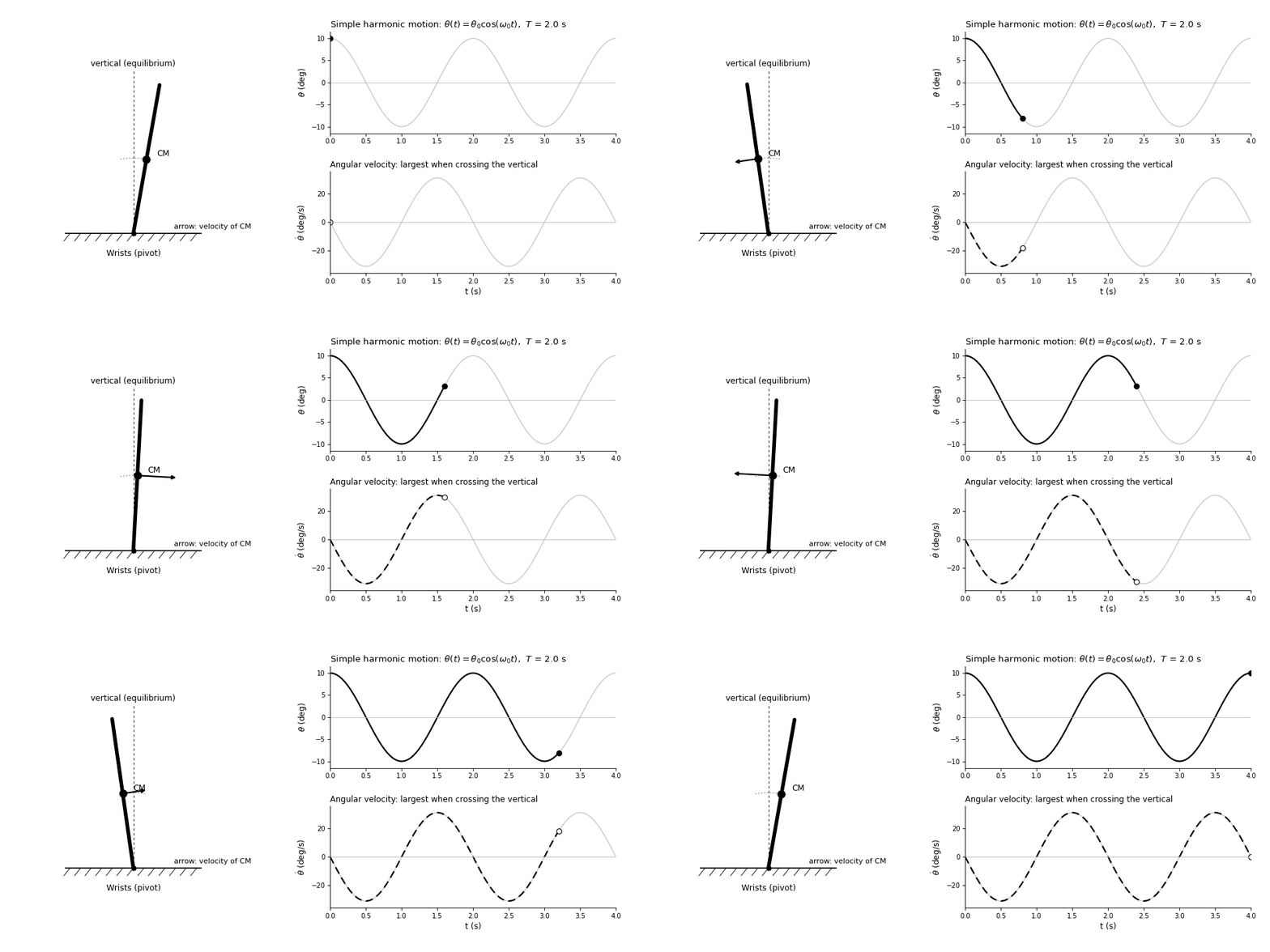
<p>In a simple hanging pendulum (the one whose body is suspended from a fixed point that swings freely under gravity) the centre of mass describes <strong>harmonic motion</strong>, at least for small oscillations. In the ideal case, the angular position over time is modelled by a cosine function, \(\theta(t) = \theta_0 \cos(\omega_0 t)\), where \(\theta_0\) is the initial amplitude and \(\omega_0\) is the angular frequency.</p>

<p>I understand this may sound tedious and long-winded, but there is a reason why understanding the difference between the hanging pendulum model and the inverted pendulum model matters.</p>

<p><em>And in case you didn’t know, I love waves.</em></p>

<p>Under this regime, its velocity continuously changes direction at the oscillation limits and varies in magnitude, reaching its maximum as the system crosses the vertical reference line.</p>

<p>This is what happens, more or less, to your centre of mass when you use you fingers to recover balance. In fact, the common wisdom about controlling a handstand revolves around this idea: if you are falling forward, push with your fingers; if you are falling backward, push with your palms. What you are being asked to do is behave like a <strong>harmonic oscillator</strong>.</p>

<p>Unfortunately for those who who genuinely approach handbalancing, as we have seen from the equation above, this result cannot be achieved without active control at the wrists (\(\tau\)).</p>

<p>Yet, an ideal inverted pendulum cannot be mathematically described by simple harmonic motion: it diverges exponentially from the vertical (for small angles). In other words, what we would like to obtain is simply not supported by the underlying physics of the system.</p>

<p>This is due to the <strong>unfavorable configuration we occupy within the gravitational field</strong>: our pivot point is located at ground level, while the entire weight of our body is distributed above and rotates around it.</p>

<p>When balancing on hands, you (the inverted pendulum) are being asked to behave like a simple pendulum, turning an unstable system into one that oscillates about the vertical (our handstand).</p>

<p>Furthermore, <em>even a real hanging pendulum does not behave like an ideal hanging pendulum</em>, and you are not a hanging pendulum. Gravity is against you, and the system you most resemble is unstable by nature: left to itself, it tends to fall.</p>

<p>In short, in a hanging pendulum, harmonic motion (which is what we want our centre of mass to do around the vertical) is the natural behaviour of the system and needs no control, because gravity provides the restoring torque that brings it back to equilibrium. In an inverted pendulum, <em>gravity pushes us away from equilibrium</em>, so we have to <em>counteract it and recreate the harmonic oscillations ourselves</em>.</p>

<p>Luckily, in reality, <em>you are not a hanging pendulum, nor a inverted one</em>, and you can train your muscles to describe what type of motion you want (differently from pendulums, they learn). So, once again: understand how the motion works, what its characteristics are, and how to reproduce it with our body.</p>

<p>With active wrist control, we can create behaviour that resembles simple harmonic motion.</p>

<p>In other words, <em>nature will not produce restoring torques for you, but at least has provided you with the neuromotor control system which can learn how to generate them</em> (Figure 3).</p>

<figure>
  <img src="/assets/img/handstand_shm.gif" alt="Simple harmonic oscillator" />

   <img src="/assets/img/shm_top_view.gif" alt="Simple harmonic oscillator" />
  <figcaption>Figure 3. Kinematic and dynamic model of a straight-arm handstand represented as an inverted pendulum. Left: Diagram of the model where the wrists act as a pivot point, while the center of mass (CM) oscillates relative to the vertical equilibrium line in lateral view (top) and top view (bottom). Top right: Graph of simple harmonic motion showing the tilt angle as a function of time (which is a cosine function), with a period T = 2.0 s. Bottom right: Plot of angular velocity, which is the time derivative of the position function and it's magnitude reaches its maximum when the body crosses the vertical.</figcaption>
</figure>

<p>In short, the ability to recover balance depends on the torque we can generate at the wrists.</p>

<h2 id="if-in-doubt-be-a-pendulum">If in doubt, be a pendulum</h2>

<p>Either way, whether you are a hanging pendulum or an inverted one, being a pendulum is what truly matters: as we will see, this is the simplest configuration to study and define, and therefore the simplest case in which to predict and contain perturbations. Unfortunately, holding the posture that makes the body behave like a pendulum is very hard, and it involves non-trivial muscle activations. This is the reason why more experienced athletes, who have greater neuromuscular control, perform better in this specific task and are better able to maintain the position. As I said at the beginning of the post, the straight handstand was the hardest position for me to learn. Not to understand, but to actually learn. Things improved when I learned the correct <strong>posterior pelvic tilt</strong>. In the next posts we will look at what these activations are and how they affect the model.</p>

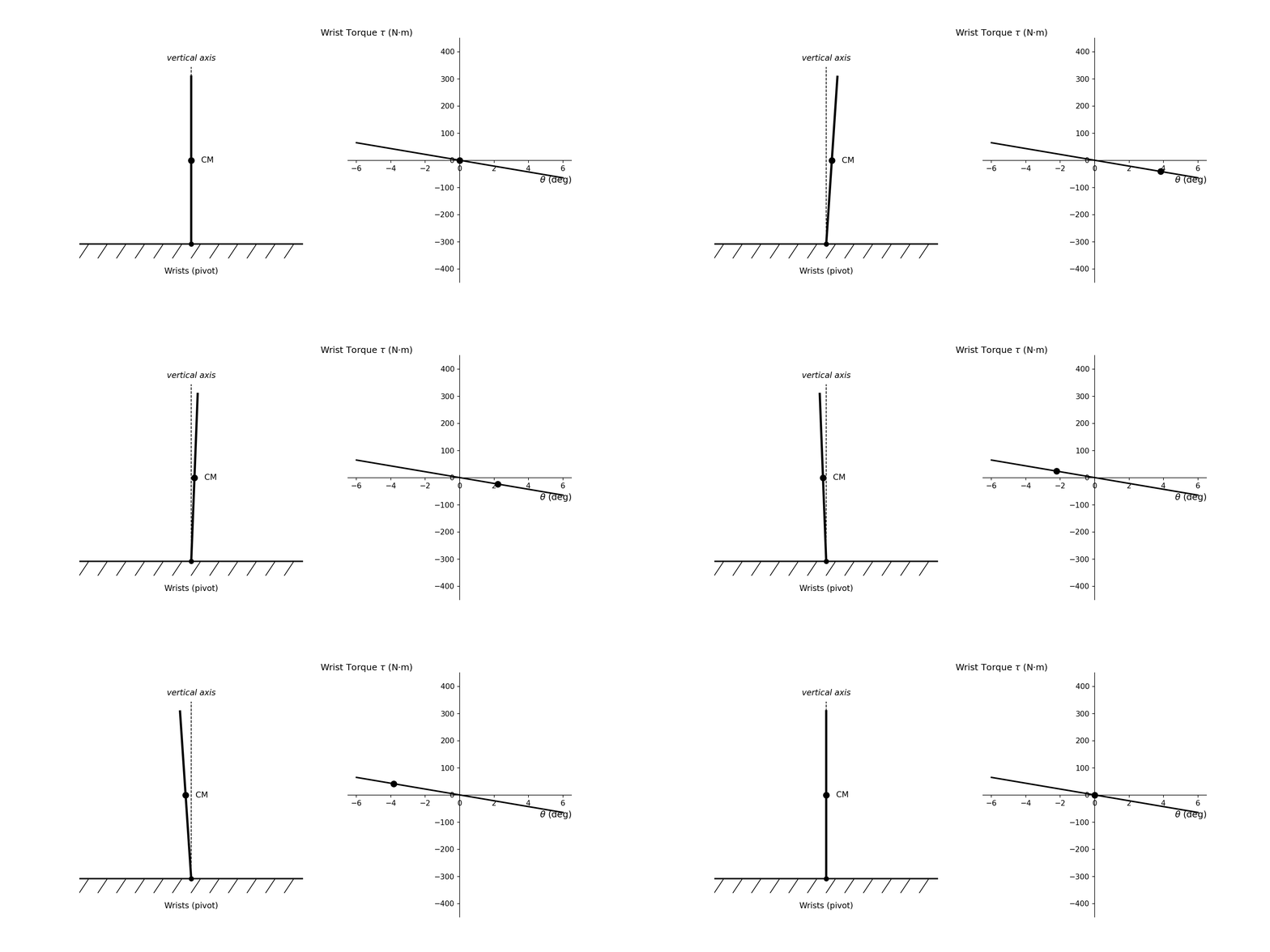
<p>Moreover, because of the dependence of \(\tau\) on \(h\), this result also suggests that the magnitude of the torque required to recover balance depends on the height of the center of mass, meaning that taller people may struggle more in handstands (Figure 4).</p>

<figure>
  <img src="/assets/img/height_com_visual.gif" alt="Height of the centre of mass" />
  <figcaption>Figure 4. The magnitude of the torque required to recover balance depends on the height of the center of mass.</figcaption>
</figure>

<p>In the next posts, we will see that other parameters also play a role and that the wrists can exert only a limited torque, bounded by the size of the contact area under the hands: if \(mgh\sin\theta\) exceeds that limit, the fall can no longer be stopped.</p>

<p>This post is part of <em><a href="/series/">the handstand balance model</a>.
<a href="https://dopamine-chamber.github.io/2026/10/20/an-energy-perspective.html">Next: an energy perspective on handstands balance →</a></em></p>

<h4 id="sources-and-references">Sources and references</h4>
<ul>
  <li>Frontiers - <a href="https://www.frontiersin.org/journals/sports-and-active-living/articles/10.3389/fspor.2025.1694648/full" target="_blank" rel="noopener noreferrer"><em>Biomechanical analyses of the handstand: a systematic review</em></a></li>
  <li>Chris Gatti - <a href="https://www.chrisgatti.com/blog/2019/10/6/a-simple-model-of-the-handstand" target="_blank" rel="noopener noreferrer"><em>A simple model of the handstand</em></a></li>
  <li>Figures 1 and 2 - <em>AI-generated illustration created with Claude (Anthropic) for</em> <a href="https://dopamine-chamber.github.io/" target="_blank" rel="noopener noreferrer"><em>dopamine-chamber.github.io</em></a></li>
  <li>Figures 3, 4 and 5 - <em>Generated via Python for</em> <a href="https://dopamine-chamber.github.io/" target="_blank" rel="noopener noreferrer"><em>dopamine-chamber.github.io</em></a></li>
</ul>]]></content><author><name>Benedetta Giglio</name></author><category term="handstand" /><category term="biomechanics" /><category term="inverted pendulum" /><category term="movement" /><category term="human movement" /><category term="model" /><category term="handstand balance model" /><summary type="html"><![CDATA[The physics behind handstands: use a simplified handstand balance model to start understanding why handstands are intrinsically unstable.]]></summary><media:thumbnail xmlns:media="http://search.yahoo.com/mrss/" url="https://www.slowconvergence.com/assets/img/handstand_shm.gif" /><media:content medium="image" url="https://www.slowconvergence.com/assets/img/handstand_shm.gif" xmlns:media="http://search.yahoo.com/mrss/" /></entry><entry><title type="html">Handstand balance: modelling the problem</title><link href="https://www.slowconvergence.com/2026/10/19/handstand-physics-balance-model.html" rel="alternate" type="text/html" title="Handstand balance: modelling the problem" /><published>2026-10-19T00:00:00+00:00</published><updated>2026-11-01T00:00:00+00:00</updated><id>https://www.slowconvergence.com/2026/10/19/handstand-physics-balance-model</id><content type="html" xml:base="https://www.slowconvergence.com/2026/10/19/handstand-physics-balance-model.html"><![CDATA[<p>There is a simple physical truth behind the ability to hold a handstand: the constant, <em>inevitable</em> pull of gravity. In fact, beneath the apparent absence of motion, a vibrant orchestra of variables contribute to the balance. To attempt to barely understand them and how they play their role in the symphony, we need a model that captures the real situation. This will be the research that, starting from there, will take place here.</p>

<p><em>A friendly disclaimer: I am not a professional hand balancer, and the aim of this project is neither to provide a method for practicing handstands nor to teach how to perform them. Its purpose is to observe the phenomenon and describe the underlying principles that make it possible. What follows is a summary of the conceptual rabbit hole I have been exploring so far.</em></p>

<h2 id="is-the-handstand-a-dilemma">Is the handstand a dilemma?</h2>

<p>For a long time, my engineering background led me to think of handbalancing as a problem of mechanical equilibrium. And for years, practicing handstands felt remarkably similar to solving a physics problem.</p>

<p><em>Which muscles should I recruit for a given task? (Which variables compose this system?)</em><br />
<em>Which is the most important? (Which is the key variable?)</em><br />
<em>How can I engage the strongest and most natural kinetic chain without introducing compensations? (Which method is the most effective?)</em></p>

<p>And yet, what people generally say about handstands sound similar to what my Physics I professor said on the first day of the course:
<em>“Sorry if this first lecture may sound complicated. Physics has no beginner level.”</em></p>

<p>Talking of handstands, it’s undeniable that <strong>the human body is not designed to balance itself on hands</strong>, nor for holding handstands for that long. Being upside down is not exactly what we evolved for. Anyway, I’m still fascinated by its <strong>ability to reorganize and adapt</strong>, even when faced with such an <em>unusual, functionally useless, mentally draining and frustrating task</em>.</p>

<p>But it’s important to go across this journey with the right amount of self-denial.
And a bit of rage.</p>

<h2 id="understanding-models-understanding-handstands">Understanding models (understanding handstands?)</h2>

<p>To understand how these beautiful things (these that happen on hands) happen, we need a <strong>model</strong> that can be grasped on the cognitive level. Therefore, over the years, my all-consuming side project has been refining this model to make it fit the handstand dilemma, and ultimately to find the perfect solution to the system. <br />
<em>And practicing handstands, of course</em>.</p>

<p><em>Editorial note: in this blog there will be a fair amount of maths. Although they’re very elegant, my mind doesn’t love formulas. But they help a lot to support and clarify what often exists only in our mind as a confused cloud. Maths can also be remarkably relaxing at times. I tend to be an anxious person, and when irrational fears creep into my mind, I like to keep them in check by using numbers to anchor myself in reality. Almost always, I find that the anxiety was only in my head, not in the facts. If something doesn’t make sense, check the toolbox and look up the relevant definition.</em></p>

<hr />

<details>
  <summary><strong>Toolbox</strong></summary>

  <ul>
    <li>
      <p><strong>Rigid body</strong>: an idealisation in which the distance between any two points of the body stays constant: the body does not deform and can only translate and rotate. In biomechanics, the human body is often represented as a rigid-body model.</p>
    </li>
    <li>
      <p><strong>Angular velocity</strong> (ω): how fast the tilt angle changes over time [rad/s]. It is the time derivative of θ.</p>
    </li>
    <li>
      <p><strong>Angular acceleration</strong> (α): how fast the angular velocity changes over time [rad/s²].</p>
    </li>
    <li>
      <p><strong>Centre of mass</strong> (CoM): the point where the whole mass of a body can be considered concentrated, and which moves like a single particle subject to the total external force.</p>
    </li>
    <li>
      <p><strong>Lever arm</strong>: the perpendicular distance between the line of action of a force and the axis of rotation [m].</p>
    </li>
    <li>
      <p><strong>Pivot</strong>: the fixed point about which the body rotates. In the model it is the wrists.</p>
    </li>
    <li>
      <p><strong>Amplitude</strong> (θ₀): the maximum angle reached during the oscillation.</p>
    </li>
    <li>
      <p><strong>Angular frequency</strong> (ω₀): how fast the oscillation cycles [rad/s]. It is related to the period by T = 2π/ω₀.</p>
    </li>
    <li>
      <p><strong>Period</strong> (T): the time taken for one complete oscillation [s].</p>
    </li>
    <li>
      <p><strong>Moment of inertia</strong> (I₀): a measure of a body’s resistance to changes in its rotation, here about the pivot (the wrists) [kg·m²].</p>
    </li>
    <li>
      <p><strong>Control torque</strong> (τ): torque generated by the muscles, equal to the force times its lever arm [N·m].</p>
    </li>
    <li>
      <p><strong>Tilt angle</strong> (θ): angle between the body axis and the vertical [rad].</p>
    </li>
  </ul>

</details>

<hr />

<p>Let’s then use maths to prove that handstands can be held, and also why they are so difficult. And for the scope, we will give a <em>little</em> definition of what a model is.</p>

<p>A model is a simplified formalization of a real phenomenon or problem, expressed in a language that can be analyzed and that retains only the relevant variables. The first step is therefore choosing the <strong>level of abstraction</strong>: we need to determine which variables are relevant. Then we have to represent them in a language that allows precise treatment (e.g. equations). On the other hand, models are valid <em>only within the domain they were built for</em>, and if reality departs from their assumptions, the model must be revised.</p>

<p>Therefore, if someone asked you: <em>“What is the best model for mathematically describing how to do a handstand?”</em>, the first answer would be: <em>“Which type of handstand?”</em><br />
And even before that: <em>what actually is a handstand?</em></p>

<p>While we were able to give a clear, agreed-upon definition for the model, the same cannot be done for the handstand. Not only because there are many different handstand variations (even if this must be considered in the model, of course), but because it is hard to define the problem itself without relying on personal experience.
<em>Handbalancing is deeply experiential, not spelled out. And complexity is part of the game.</em></p>

<p>Therefore, modelling something that is hard to describe in explicit terms is no walk in the park. 
Regarding the level of abstraction, actually, I have trouble leaving out irrelevant aspects. I have a mind that tends to dwell on everything, analyzing it for so long that the rest of the world starts to flow past behind it while I end up <em>down the rabbit hole</em>, carrying along everything I found on the way. In short, for me, it calls for an in-depth study.</p>

<p>Anyway, from now on, trying to model the problem will happen on the three <strong>anatomical planes</strong> onto which <strong>human movement</strong> can be projected: the frontal (or coronal) plane, the transverse (or horizontal) plane, and the sagittal (or median) plane (Figure 1).</p>

<figure>
  <img src="/assets/img/planes_of_human_movement.png" alt="Frontal, sagittal, and transverse planes through a standing human figure" />
  <figcaption>Figure 1. Anatomical body planes.</figcaption>
</figure>

<p><em>Armed with these colorful hopes</em>, we will analyse all the problems of the handstand and try to isolate them, study them one by one, and then combine them into a cocktail party that should be our handstand. We will use formulas, see with our own eyes the dependence on the parameters, and make some assumptions. And, as we know, answers will be valid only within the assumptions we chose.</p>

<h2 id="a-pinch-of-assumptions-and-a-first-model-the-body-is-a-stick">A pinch of assumptions and a first model: the body is a stick</h2>

<p>Let’s start with a first extremely simplified model. First, we have to make our <strong>boring but necessary assumptions</strong>: don’t worry, these are the most relevant and we will treat them as given in the next posts.</p>

<ul>
  <li>First, we suppose that the handstand system is perfectly symmetrical, with two arms pushing with the same force and in the same direction.<br /></li>
  <li>We assume zero inclination in the frontal plane, and consider only the inclination that occurs in the sagittal plane when we push with both fingers and palms to adjust the balance.<br /></li>
  <li>We also assume that arms, shoulders, hips and legs work identically and do not generate twists.</li>
  <li>We initially treat the human body as a <strong>single rigid body</strong>, so that we can describe its motion through the position of its <strong>centre of mass</strong>.<br /></li>
  <li>We see its motion from the sagittal plane, which divides the head (or brain) from the rest of the body into right and left sections (Figure 2):</li>
</ul>

<figure>
  <img src="/assets/img/single_segment_handstand_pendulum_model.png" alt="Handstand modelled as a single rigid segment pivoting about the wrists, with the centre of mass marked" />
  <figcaption>Figure 2. The body modelled as a single element described by its center of mass.</figcaption>
</figure>

<p>In this easy but not simple body configuration, the governing equation is Newton’s second law:</p>

\[\sum \mathbf{F} = m\mathbf{a}_{CM}\]

<p>When the centre of mass translates in the sagittal plane due to physiological handstand revocery swings, gravity will produce a moment about the wrists we can write this way:</p>

\[\sum M_{O} = I_{O}\,\alpha = mgh+\tau\]

<p>where \(\tau\) is the active control of the wrists. 
When we hold a handstand, the net moment must be zero, meaning there are no accelerations and the moment generated by gravity is perfectly counteracted by the torque generated by the wrists:</p>

\[mgh+\tau = 0 \Rightarrow mgh = - \tau\]

<p>In a real handstand, however, the body is never perfectly stationary and perpendicular to the floor. Small adjustments are performed at the hand level, which means the acceleration is not zero. In the next post, we will introduce dynamics and analyze the torques that keep the body (barely) upright.</p>

<p>This post is part of <em><a href="/series/">the handstand balance model</a>.
<a href="https://dopamine-chamber.github.io/2026/10/20/straight-two-arm-handstand-model.html">Next: a more accurate handstand balance model →</a></em></p>

<h4 id="sources-and-references">Sources and references</h4>

<ul>
  <li>Royal Society Open Science - <a href="https://doi.org/10.1098/rsos.161018" target="_blank" rel="noopener noreferrer"><em>Balance control strategies during perturbed and unperturbed balance in standing and handstand</em></a> (<a href="https://www.ncbi.nlm.nih.gov/pmc/articles/PMC5541526/" target="_blank" rel="noopener noreferrer">open access</a>)</li>
  <li>Medicine &amp; Science in Sports &amp; Exercise - <a href="https://pubmed.ncbi.nlm.nih.gov/11445766/" target="_blank" rel="noopener noreferrer"><em>Strategies for maintaining a handstand in the anterior-posterior direction</em></a></li>
  <li>Loughborough repository - <a href="https://repository.lboro.ac.uk/articles/journal_contribution/Control_strategy_for_a_hand_balance/9630269" target="_blank" rel="noopener noreferrer"><em>Control strategy for a hand balance</em></a></li>
  <li>Gait &amp; Posture - <a href="https://doi.org/10.1016/0966-6362(96)82849-9" target="_blank" rel="noopener noreferrer"><em>Human balance and posture control during standing and walking</em></a></li>
  <li>Figures 1, 2: <em>AI-generated illustration created with Claude (Anthropic) for</em> <a href="https://dopamine-chamber.github.io/" target="_blank" rel="noopener noreferrer"><em>dopamine-chamber.github.io</em></a></li>
</ul>]]></content><author><name>Benedetta Giglio</name></author><category term="handstand" /><category term="biomechanics" /><category term="inverted pendulum" /><category term="movement" /><category term="handbalancing" /><category term="balance" /><category term="human movement" /><category term="model" /><summary type="html"><![CDATA[Handstands are far from stationary. A first physical model of handstand balance, and why holding one is so hard.]]></summary><media:thumbnail xmlns:media="http://search.yahoo.com/mrss/" url="https://www.slowconvergence.com/assets/img/handstand-physics-balance-model.png" /><media:content medium="image" url="https://www.slowconvergence.com/assets/img/handstand-physics-balance-model.png" xmlns:media="http://search.yahoo.com/mrss/" /></entry></feed>